ko / こ
The last of the K row — two small parallel marks that pack into words for children, here, and high places.
Pronunciation
The character こ represents the syllable 'ko', a hard 'k' followed by 'o'. Part of the か-row. The shape is one of the simplest in hiragana — just two short curving lines stacked.
こ closes the K row and is one of the simplest hiragana to write — two short strokes. It anchors the こ-row and means "child" all by itself in compounds (子 in 子供 "child", in 男の子 "boy"). The demonstrative pair ここ (here) and こちら (this way) are among the first words most beginners use.
How to write こ
Trace こ on the canvas at the top of the page. Animated arrows show each stroke's direction; trace along them and the stroke fills in. Each numbered step below explains what that stroke does.

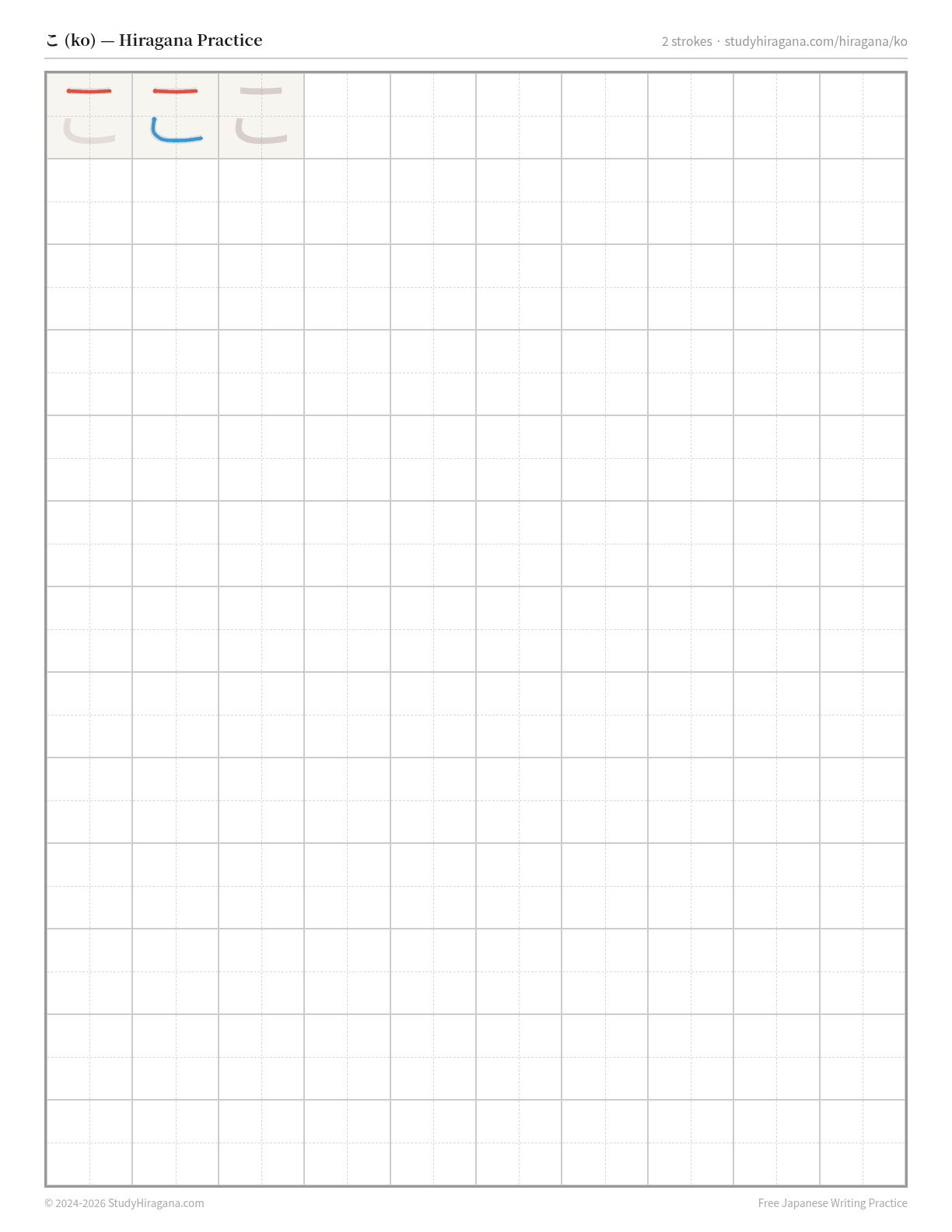
A short curved horizontal stroke at the top. Draw left to right with a faint downward hook on the right end.
A second, parallel curved stroke below the first, slightly longer. The two strokes look like two strands of grass leaning slightly to the right — simple but distinctive.
Origin
Hiragana こ comes from the cursive form of the kanji 己 (ko) — meaning "self." Centuries of scribes simplified the kanji's three angular strokes into the two flowing horizontals of こ, preserving the stacked rhythm but dropping the corners.
Common words starting with こ
Printable practice sheet
Print this worksheet to practice writing こ by hand — the top row shows the stroke order to trace, then fill the blank squares.
Lock it into memory
Reading is only half of it. Write the hiragana you’ve learned from memory in the trainer — the ones you struggle with come back sooner, until they stick.