ki / き
The second of the K row — sharp, bright 'ki' that opens dozens of words for trees, feelings, and direction.
Pronunciation
The character き represents the syllable 'ki', a hard 'k' followed by 'i' as in 'machine'. It is part of the か-row. Like the other characters in this row, the 'k' sound is unaspirated.
き sits second in the K row and shows up in everything from 木 (tree) to 気 (mood, feeling, spirit). It's a workhorse character — once you can read it, hundreds of beginner words open up. In compounds it can voice into ぎ, but the base sound is always the same crisp 'ki'.
How to write き
Trace き on the canvas at the top of the page. Animated arrows show each stroke's direction; trace along them and the stroke fills in. Each numbered step below explains what that stroke does.
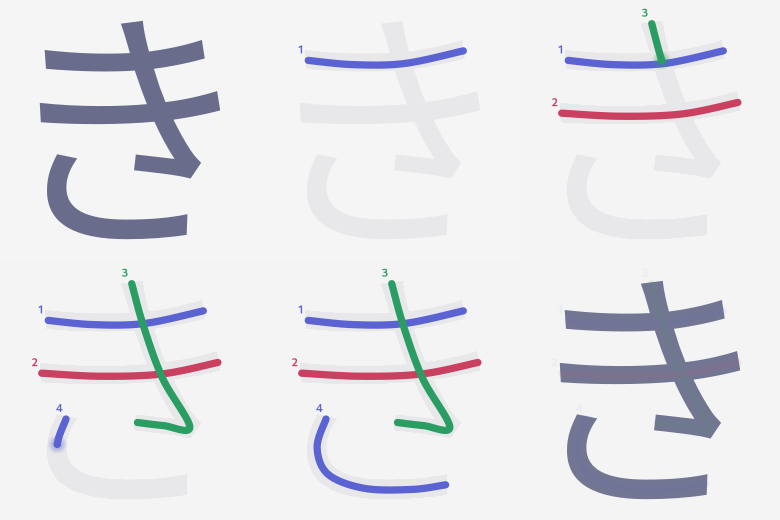
A short, slightly slanted horizontal mark at the top — sets the upper boundary.
A second horizontal stroke below the first, parallel, a little longer.
A long vertical stroke that drops down through both horizontals, ending with a flowing curve to the right and a small flick. The bottom curve is き's defining feature — it gives the character its forward-leaning energy.
Origin
Hiragana き traces back to the cursive form of the kanji 幾 (ki) — meaning "how many" or "some." The two horizontal strokes preserve the kanji's stacked structure; the long curving stroke flows directly from its bottom-left arm.
Common words starting with き
Printable practice sheet
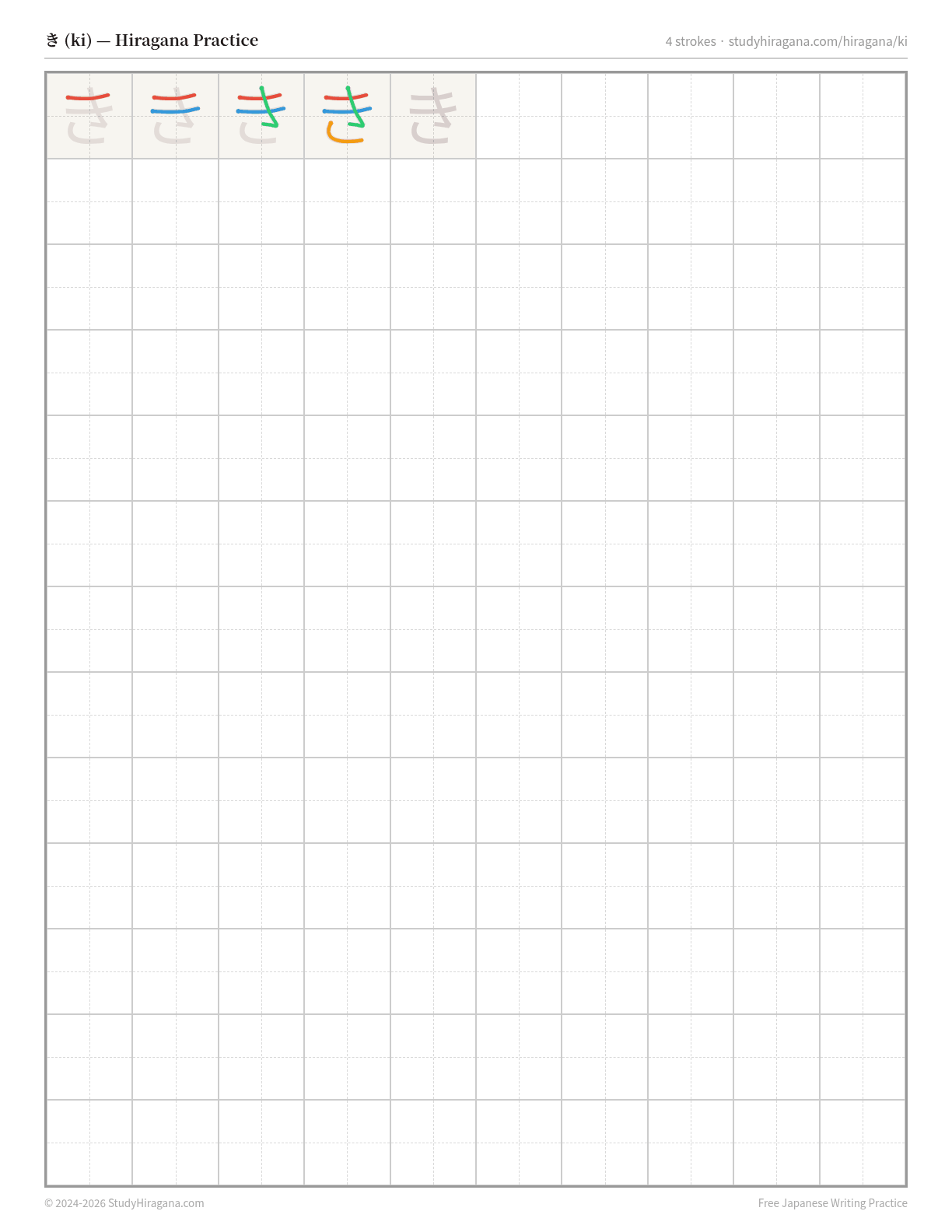
Print this worksheet to practice writing き by hand — the top row shows the stroke order to trace, then fill the blank squares.
Lock it into memory
Reading is only half of it. Write the hiragana you’ve learned from memory in the trainer — the ones you struggle with come back sooner, until they stick.