ke / け
The fourth of the K row — a balanced 'ke' that pairs with vowels to build many of the most common Japanese words.
Pronunciation
The character け represents the syllable 'ke', a hard 'k' followed by 'e' as in 'pet'. Part of the か-row.
け anchors the け-row and shows up in everyday verbs (受ける to receive, 出かける to go out), in everyday nouns (毛 hair, 池 pond), and in the polite verb endings -けど ("but") that beginners use all the time. The shape is closely related to は, ほ, and ま — once you can write け, those follow naturally.
How to write け
Trace け on the canvas at the top of the page. Animated arrows show each stroke's direction; trace along them and the stroke fills in. Each numbered step below explains what that stroke does.
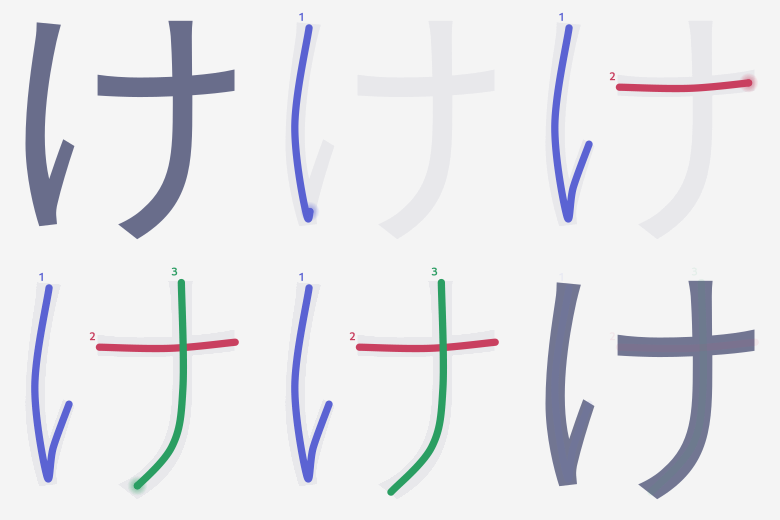
A short vertical line on the left. Draw top to bottom — straight or with a faint inward curve.
A short horizontal stroke that crosses the first stroke near the top, extending to the right.
A flowing vertical stroke on the right that drops from the top, crosses the horizontal, and ends with a small curve to the lower left. This is what gives け its forward, anchored shape.
Origin
Hiragana け evolved from the cursive form of the kanji 計 (kei) — meaning "to measure" or "to plan." The kanji's left radical (言) flowed into the simple three-stroke shape of け, keeping the vertical-horizontal-vertical balance of the original.
Common words starting with け
Printable practice sheet
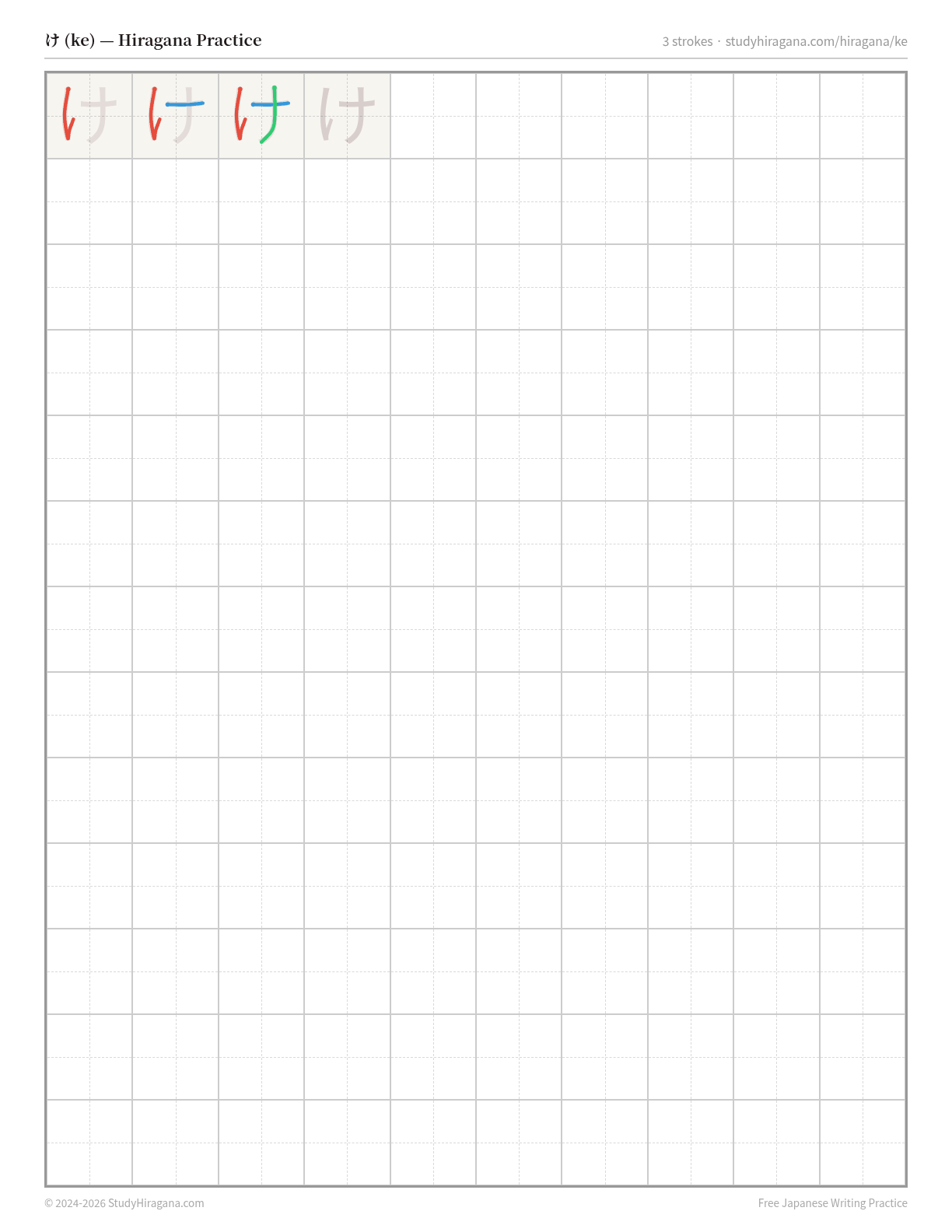
Print this worksheet to practice writing け by hand — the top row shows the stroke order to trace, then fill the blank squares.
Lock it into memory
Reading is only half of it. Write the hiragana you’ve learned from memory in the trainer — the ones you struggle with come back sooner, until they stick.