ka / か
The first character of the K row — a clean, hard 'ka' that anchors a hundred everyday words.
Pronunciation
The character か represents the syllable 'ka', a hard 'k' followed by 'a' as in 'father'. It is the first character of the か-row and is widely used in everyday Japanese vocabulary. The 'k' sound is unaspirated — softer than the English 'k'.
か anchors the か-row (か, き, く, け, こ) — every consonant + vowel pattern in Japanese starts here. It also appears at the END of questions, where it works like a spoken question mark: 元気ですか (Are you well?). Doubled in compounds as っか, it sharpens into a held 'k'.
How to write か
Trace か on the canvas at the top of the page. Animated arrows show each stroke's direction; trace along them and the stroke fills in. Each numbered step below explains what that stroke does.
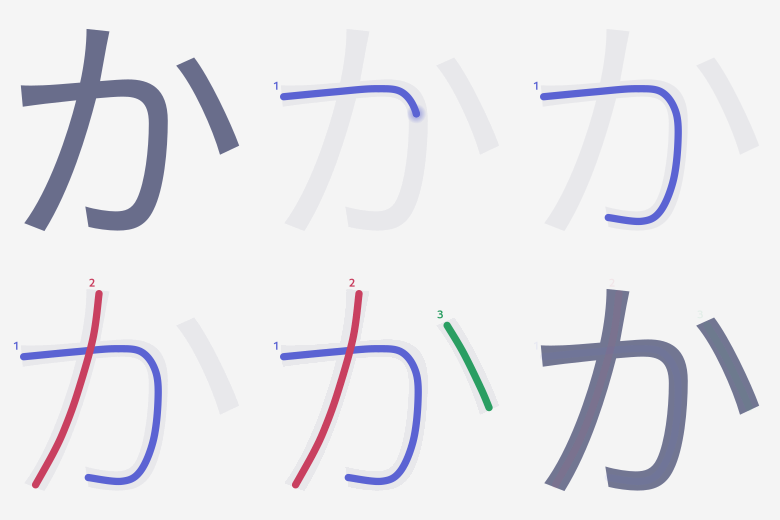
A long curved stroke that drops from the upper left to the lower right. Start at the top, sweep down and to the right, ending with a small upward hook — almost like a comma reversed.
A short horizontal stroke that crosses the first stroke about a third of the way down. Quick and clean.
A single small dot or short slanted mark to the right of the first stroke, near the top. Tiny but essential — it's what distinguishes か from や.
Origin
Hiragana か evolved from the cursive form of the kanji 加 (ka) — meaning "add" or "join." The long sweeping stroke preserves the kanji's left radical (力); the small detached mark on the upper right is what's left of its right side.
Common words starting with か
Printable practice sheet
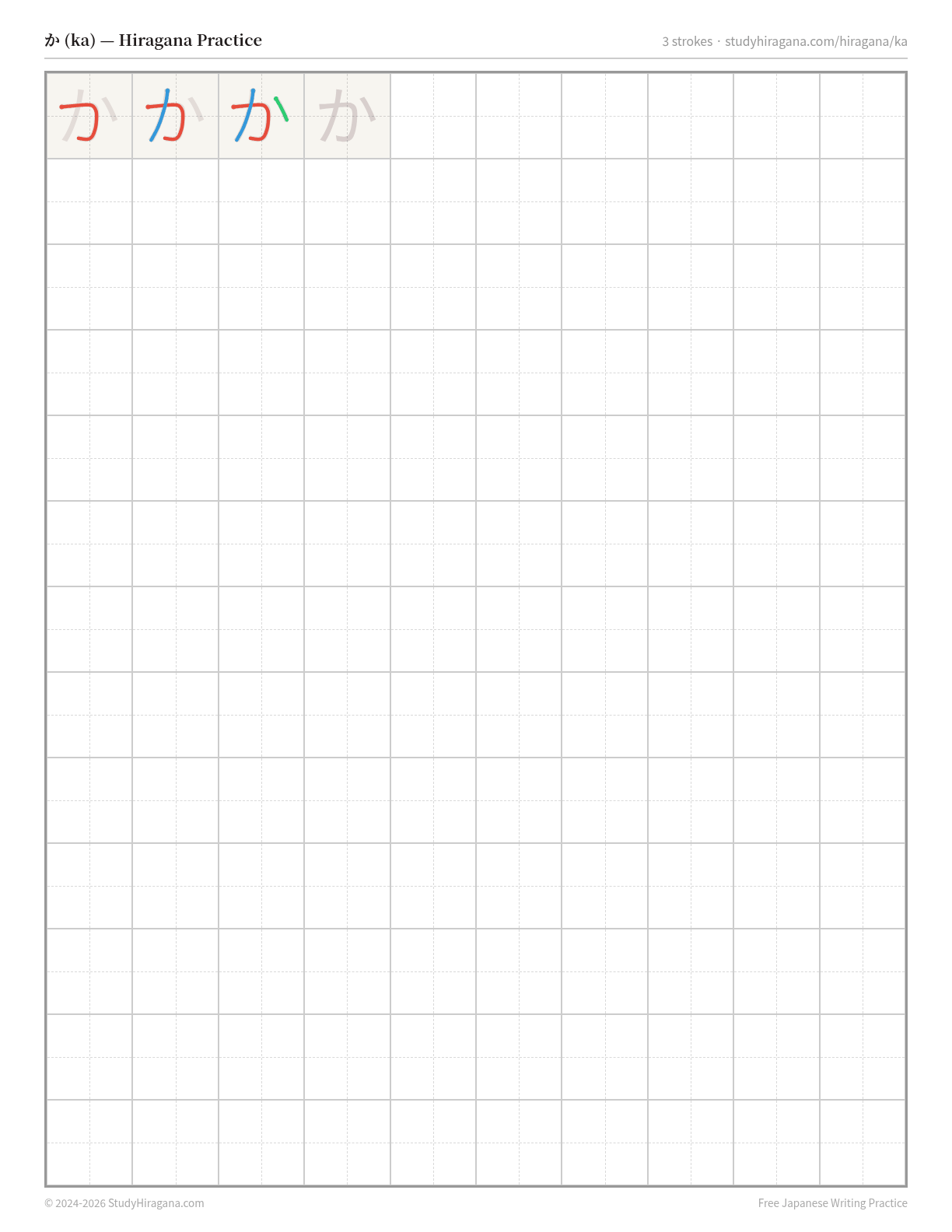
Print this worksheet to practice writing か by hand — the top row shows the stroke order to trace, then fill the blank squares.
Lock it into memory
Reading is only half of it. Write the hiragana you’ve learned from memory in the trainer — the ones you struggle with come back sooner, until they stick.