so / そ
The last of the S row — a quick two-stroke 'so' that opens words for sky, sushi-sides, and the all-purpose interjection 'so'.
Pronunciation
The character そ represents the syllable 'so', a soft 's' followed by 'o'. Part of the さ-row. The shape has a distinctive zigzag or lightning-bolt flow.
そ closes the S row and appears in the demonstrative そこ (there), the casual interjection そう ("that's right", "oh"), and dozens of nouns (空 sky, 外 outside in compound forms). It's also the source of the polite ending 〜そう (it seems / it looks). The shape has two clear variants — a single flowing stroke vs. two — and your handwriting can use either.
How to write そ
Trace そ on the canvas at the top of the page. Animated arrows show each stroke's direction; trace along them and the stroke fills in. Each numbered step below explains what that stroke does.
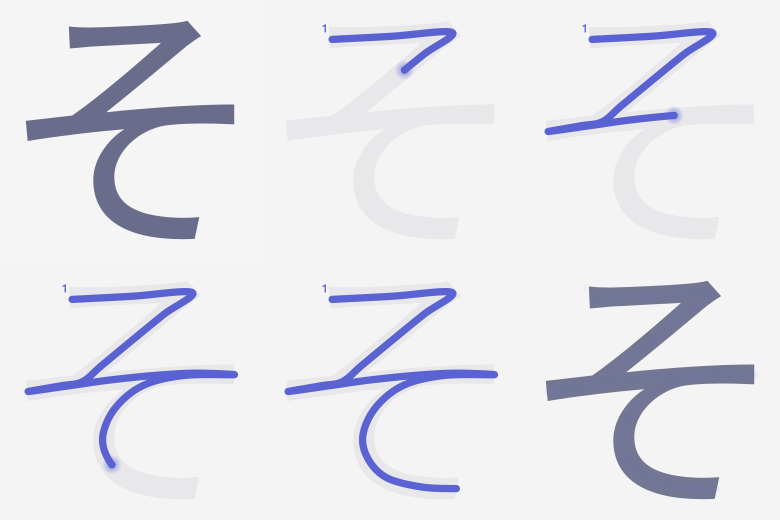
A short, slightly curved stroke at the top — a small accent shape, sometimes detached. In some fonts and handwritings this is fused into a single bigger stroke.
A long flowing stroke that begins just below the first, zigzags down through the middle (with sharp angles or a smooth wave depending on the style), and ends with a flowing curve to the lower left. The zigzag is そ's distinctive motion.
Origin
Hiragana そ traces back to the cursive form of the kanji 曽 (so) — meaning "former" or "once." The kanji's stacked square layers compressed into the zigzagging body of そ; the small top accent preserves what's left of the kanji's uppermost crown.
Common words starting with そ
Printable practice sheet
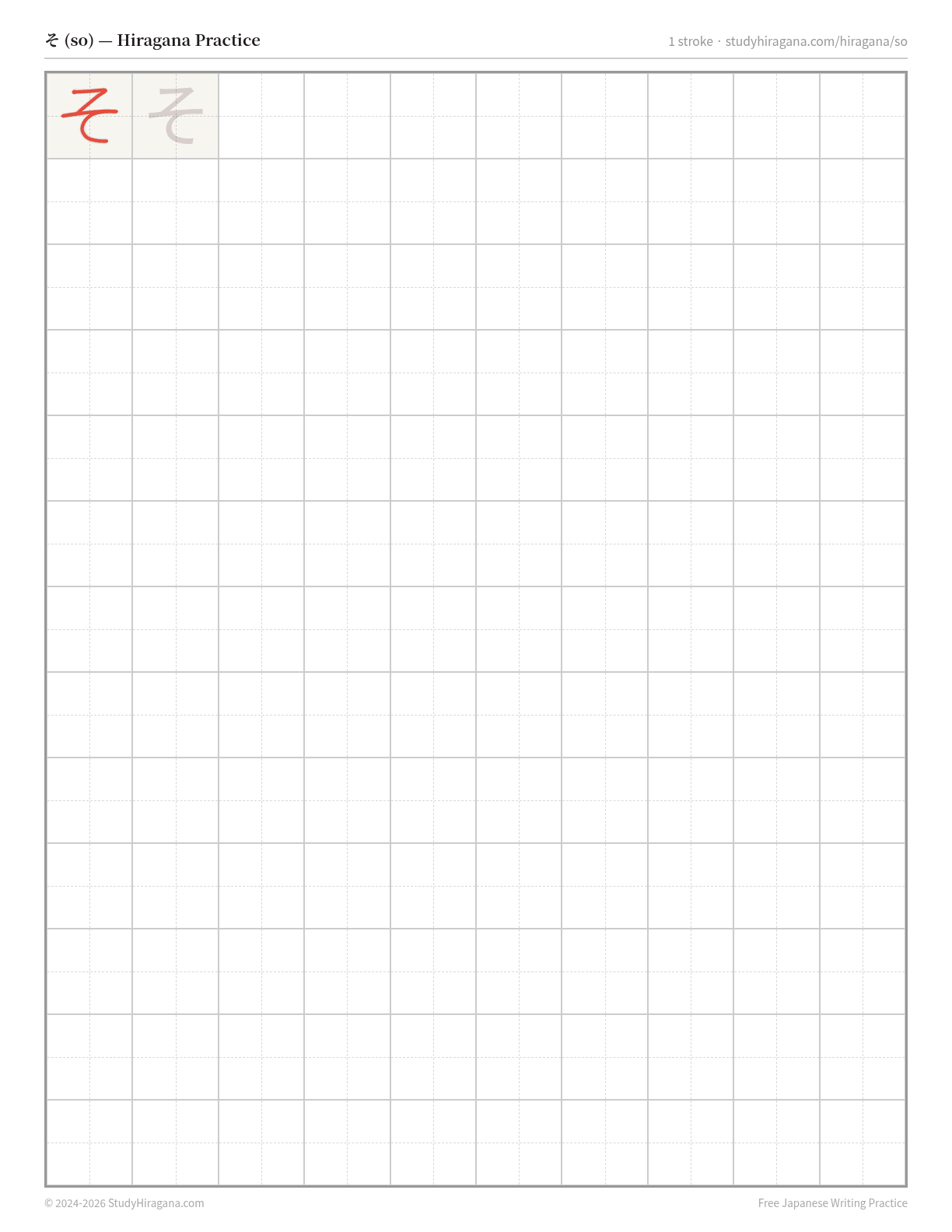
Print this worksheet to practice writing そ by hand — the top row shows the stroke order to trace, then fill the blank squares.
Lock it into memory
Reading is only half of it. Write the hiragana you’ve learned from memory in the trainer — the ones you struggle with come back sooner, until they stick.