shi / し
The second of the S row — a single sweeping stroke that doubles as the irregular reading 'shi' (not 'si').
Pronunciation
The character し represents the syllable 'shi', a soft 'sh' sound followed by 'i'. Note: it is NOT pronounced 'si' — there is no 'si' sound in standard Japanese; the 'sh' sound always replaces it in this position. Part of the さ-row.
し is one of the simplest hiragana — a single curving stroke. Despite the simple shape, it's incredibly common: it stems verbs like 死ぬ (to die), 知る (to know), 〜します (the polite verb ending). It also appears as the noun-marker し in lists ("this, and this, and that"). Once you can write し, the polite ending 〜ます is half-spelled.
How to write し
Trace し on the canvas at the top of the page. Animated arrows show each stroke's direction; trace along them and the stroke fills in. Each numbered step below explains what that stroke does.

A single long curving stroke. Start at the upper right, sweep down and to the left, curving gently as you descend, then flick up at the very bottom into a small hook. One smooth motion — no lifts. The hook at the end is what visually distinguishes し from a plain comma.
Origin
Hiragana し derives from the cursive form of the kanji 之 (shi) — meaning "of" or "this." The kanji's flowing brushstrokes compressed over centuries into the single curving stroke we write today, preserving only the rightward sweep and the small ending hook.
Common words starting with し
Printable practice sheet
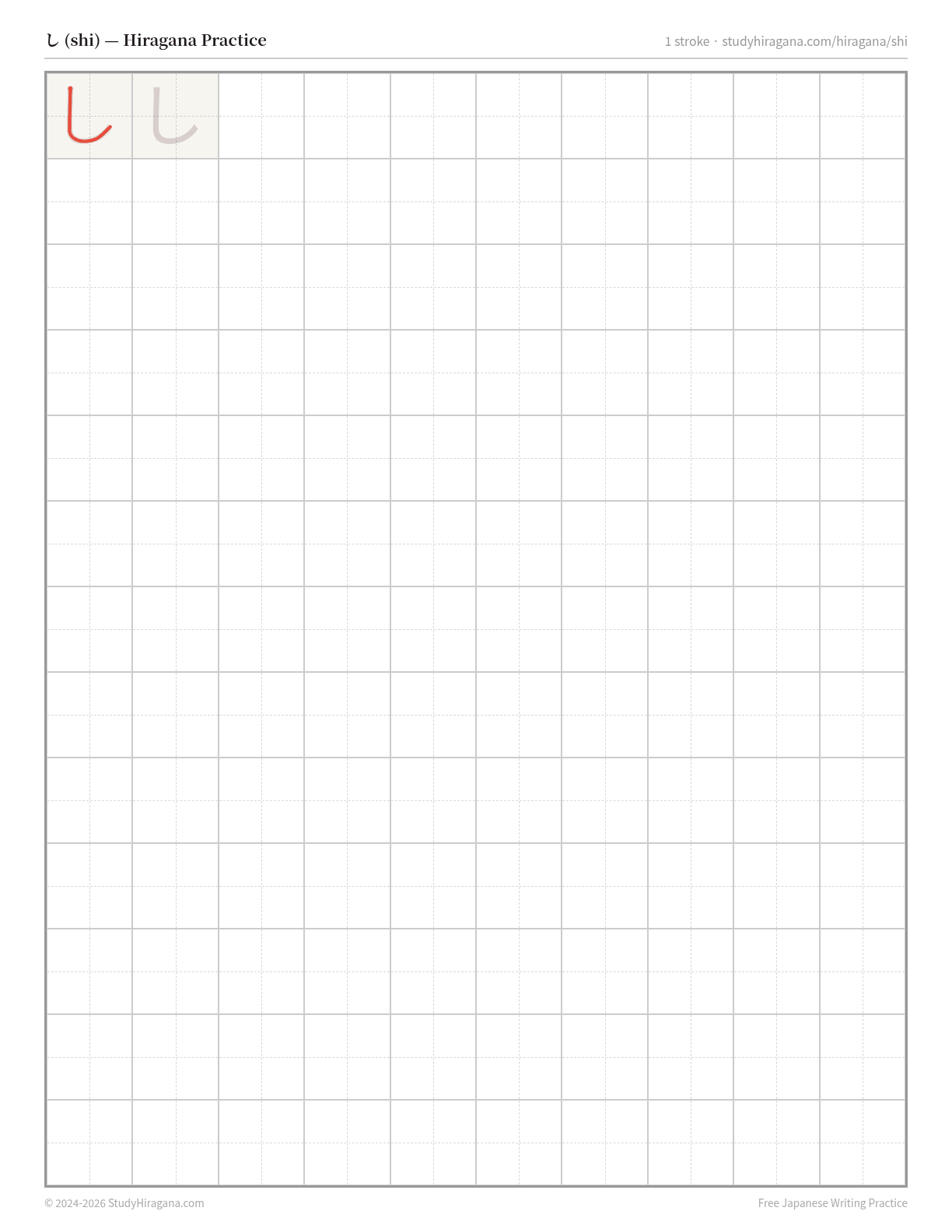
Print this worksheet to practice writing し by hand — the top row shows the stroke order to trace, then fill the blank squares.
Lock it into memory
Reading is only half of it. Write the hiragana you’ve learned from memory in the trainer — the ones you struggle with come back sooner, until they stick.