se / せ
The fourth of the S row — a balanced 'se' that opens words for back, world, and sweets.
Pronunciation
The character せ represents the syllable 'se', a soft 's' followed by 'e' as in 'pet'. Part of the さ-row.
せ anchors the せ-row and packs into useful beginner nouns — 世界 (world), 背 (back), and 先生 (teacher, the central word in any classroom). It also appears in question fillers (なぜ "why") and many polite verb forms (〜ません, negative ending). Three quick strokes; balanced and angular.
How to write せ
Trace せ on the canvas at the top of the page. Animated arrows show each stroke's direction; trace along them and the stroke fills in. Each numbered step below explains what that stroke does.
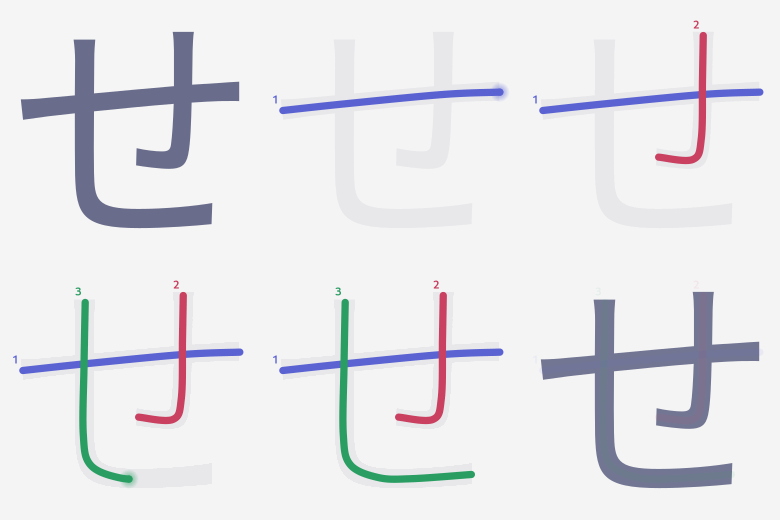
A short horizontal stroke at the top — establishes the upper bound.
A vertical stroke that drops from near the top horizontal down to roughly two-thirds of the character height. Straight or with a faint inward curve.
A long flowing horizontal stroke that crosses near the bottom, hooks gently down at the right end, and pulls the character together. This bottom stroke is what gives せ its energetic, leaning-forward feel.
Origin
Hiragana せ evolved from the cursive form of the kanji 世 (sei) — meaning "world" or "generation." The kanji's grid of horizontals and verticals collapsed into the three-stroke shape of せ, preserving the horizontal-vertical-horizontal rhythm but dropping the corners and ticks.
Common words starting with せ
Printable practice sheet
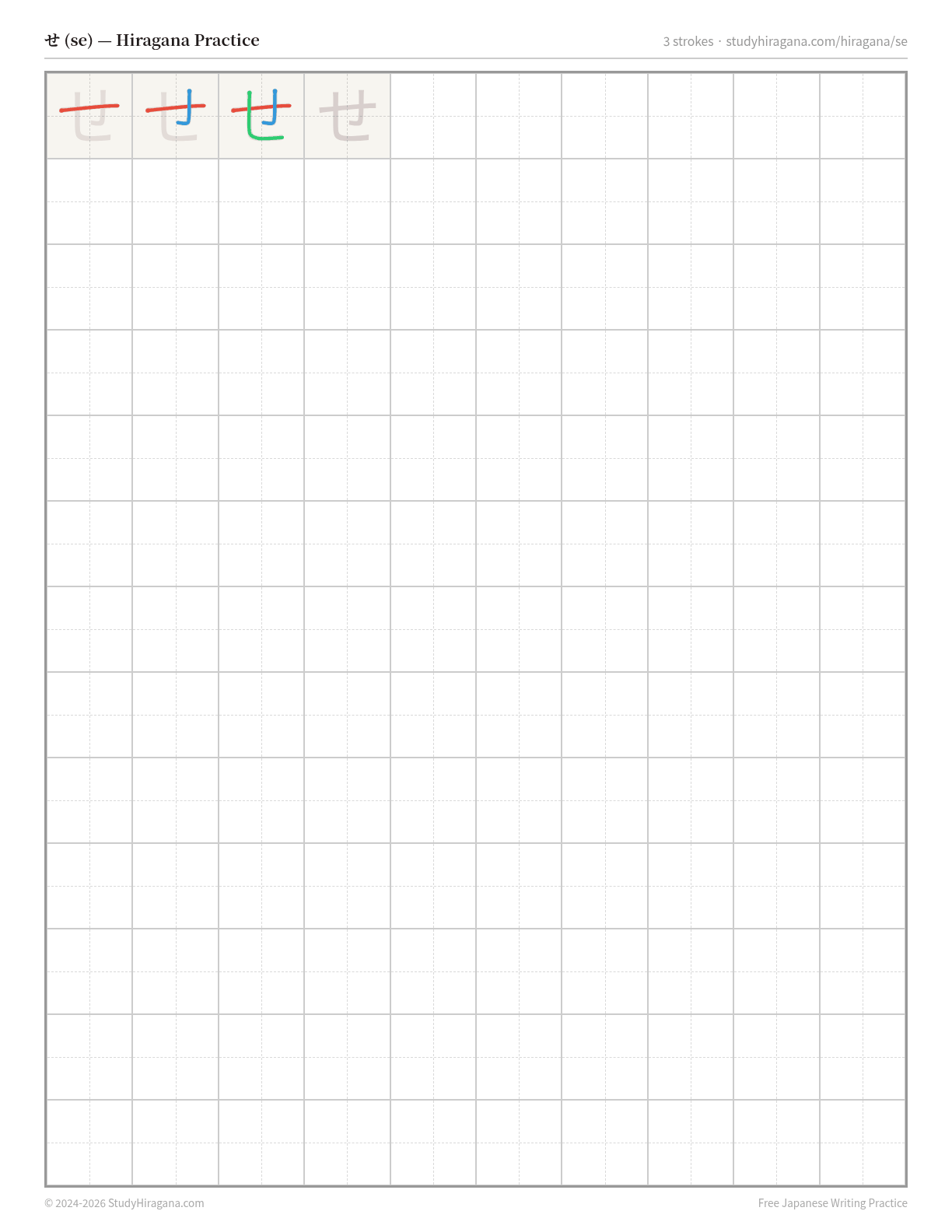
Print this worksheet to practice writing せ by hand — the top row shows the stroke order to trace, then fill the blank squares.
Lock it into memory
Reading is only half of it. Write the hiragana you’ve learned from memory in the trainer — the ones you struggle with come back sooner, until they stick.