hi / ひ
The second of the H row — a single curving stroke 'hi' that opens words for fire, light, people, and days.
Pronunciation
The character ひ represents the syllable 'hi', a soft 'h' followed by 'i'. Part of the は-row. In rapid speech the 'h' before 'i' can sound slightly more breathy than English 'h'.
ひ is one of the simplest hiragana — a single curving stroke. Despite the simple shape, it packs into many essential words: 人 (person), 日 (sun, day), 火 (fire), 光 (light). It also appears in the casual greeting 久しぶり ("long time no see") and in dozens of compound adjectives. The shape looks like a smile — a small arc with the corners turned up.
How to write ひ
Trace ひ on the canvas at the top of the page. Animated arrows show each stroke's direction; trace along them and the stroke fills in. Each numbered step below explains what that stroke does.
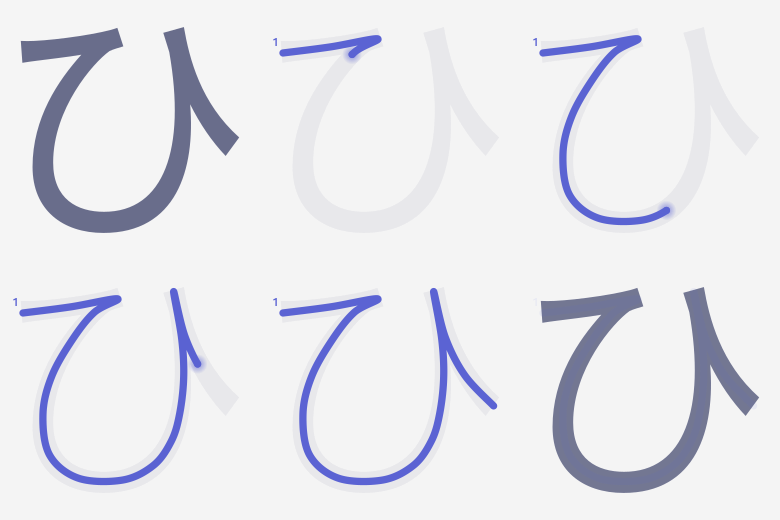
A single curving stroke. Start at the upper left, drop down with a gentle curve, sweep across the bottom like a small valley, and finish with a quick flick upward on the upper right. The character should look like a wide, shallow smile — one smooth motion, no lifts.
Origin
Hiragana ひ traces back to the cursive form of the kanji 比 (hi) — meaning "to compare." The kanji's two mirrored side-by-side strokes compressed into the single curving line we write today, preserving only the rising and falling motion of the original.
Common words starting with ひ
Printable practice sheet
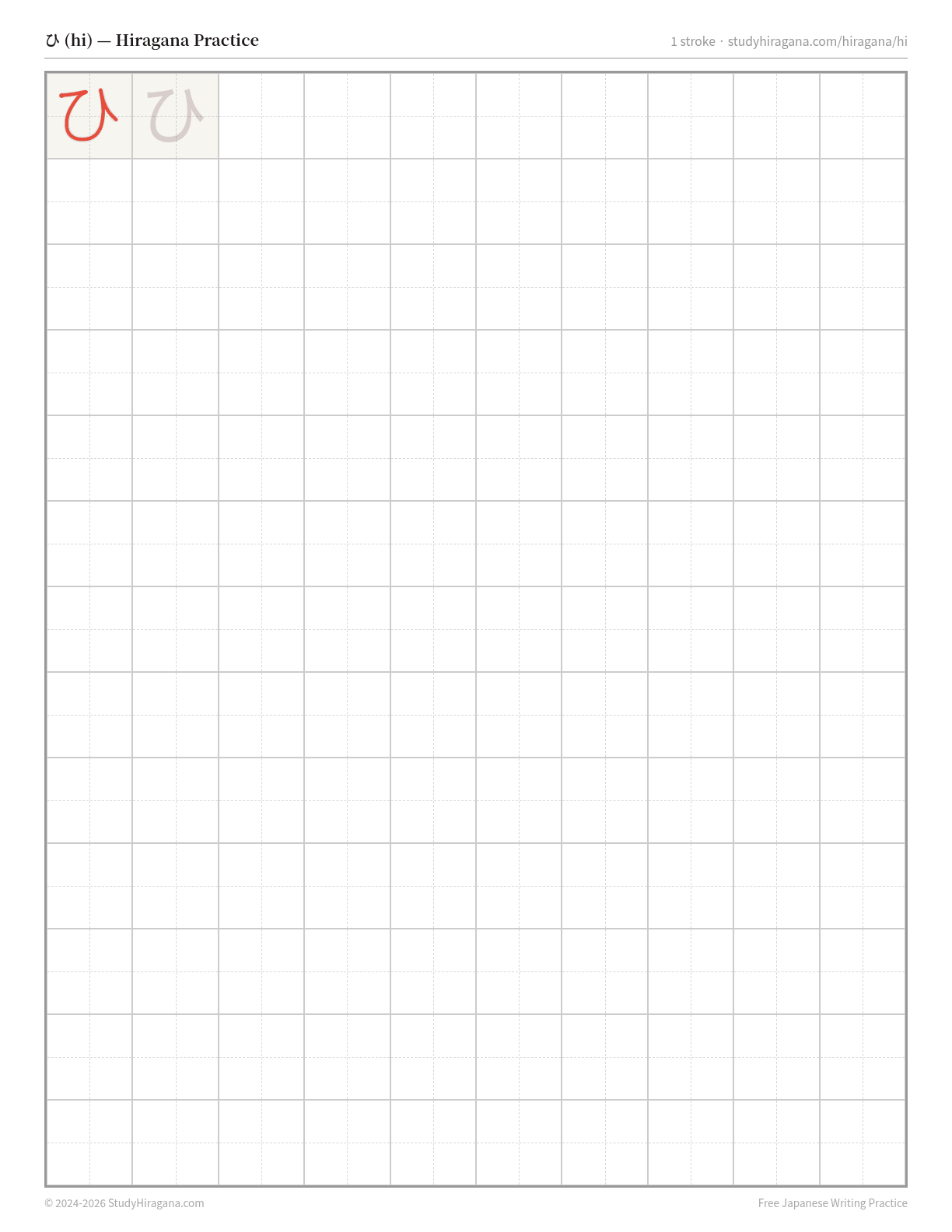
Print this worksheet to practice writing ひ by hand — the top row shows the stroke order to trace, then fill the blank squares.
Lock it into memory
Reading is only half of it. Write the hiragana you’ve learned from memory in the trainer — the ones you struggle with come back sooner, until they stick.