fu / ふ
The middle of the H row — a soft 'fu' (not 'hu'), the fourth irregular romanisation in the chart and one of the gentlest sounds in Japanese.
Pronunciation
The character ふ represents the syllable 'fu', a soft 'f' followed by 'u'. The Japanese 'f' is bilabial — pronounced with both lips, not by biting the lower lip as in English. It sounds like a gentle blowing of air. Part of the は-row.
ふ is the fourth irregular romanisation in the chart (after し, ち, つ): the consonant softens to a whispered 'f' before the う vowel — so we write fu, not hu. The sound is barely there: lips relaxed, almost like blowing out a candle. It anchors 冬 (winter), 服 (clothes), 船 (boat), 風 (wind), and dozens of beginner nouns. Four short strokes; visually busy compared to its quiet sound.
How to write ふ
Trace ふ on the canvas at the top of the page. Animated arrows show each stroke's direction; trace along them and the stroke fills in. Each numbered step below explains what that stroke does.

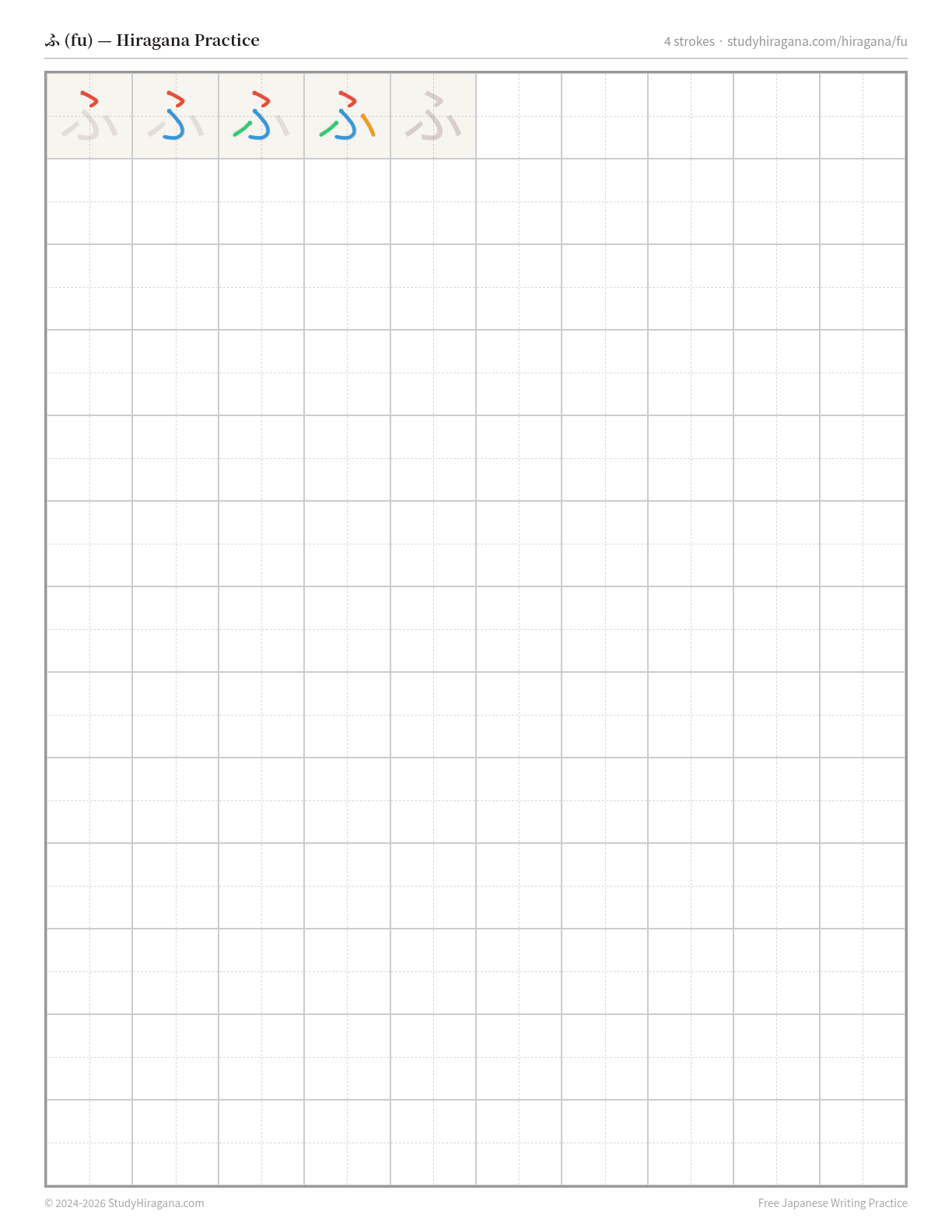
A short dot or curved mark at the upper middle — a small accent shape, quick.
A short downward stroke just below stroke 1, dropping a little to the left — almost a comma.
A short slanted stroke on the left, lower down — a small angular mark.
A short slanted stroke on the right, mirroring stroke 3 — another small angular mark. The two small marks on either side of the central drop give ふ its scattered, brushstroke-like appearance.
Origin
Hiragana ふ derives from the cursive form of the kanji 不 (fu) — meaning "not" or "un-." The kanji's top horizontal and central downstroke survived as the upper part of ふ; the lower-left and lower-right slanted dashes preserve what's left of its bottom angled strokes.
Common words starting with ふ
Printable practice sheet
Print this worksheet to practice writing ふ by hand — the top row shows the stroke order to trace, then fill the blank squares.
Lock it into memory
Reading is only half of it. Write the hiragana you’ve learned from memory in the trainer — the ones you struggle with come back sooner, until they stick.