he / へ
The fourth of the H row — a single quick stroke 'he' that doubles as the direction particle, pronounced 'e' in that role.
Pronunciation
The character へ represents the syllable 'he', a soft 'h' followed by 'e' as in 'pet'. Part of the は-row. The particle へ (pronounced 'e' when used as a directional marker meaning 'to' or 'towards') is one of the most common particles in Japanese.
へ is one of the simplest hiragana — a single rising-then-falling stroke, almost a small mountain. As a regular kana it's pronounced he and appears in 部屋 (room), 下手 (unskilled). But like は, へ pulls double duty as a particle: it marks the destination of motion ("to / toward"). In that role, へ is pronounced e, not he (another spelling relic). Whenever you see へ between a place noun and a verb of motion, say e.
How to write へ
Trace へ on the canvas at the top of the page. Animated arrows show each stroke's direction; trace along them and the stroke fills in. Each numbered step below explains what that stroke does.

A single stroke shaped like a low, broad mountain. Start at the lower left, rise diagonally upward to a sharp peak just right of centre, then drop back down diagonally to the lower right. Quick, angular — no curves. The character should look like a shallow upside-down V or a child's drawing of a hill.
Origin
Hiragana へ evolved from the cursive form of the kanji 部 (he as an archaic reading) — meaning "section" or "part." The kanji's complex layered strokes collapsed into a single rising-and-falling stroke, preserving only the upward then downward motion of its right-side radical.
Common words starting with へ
Printable practice sheet
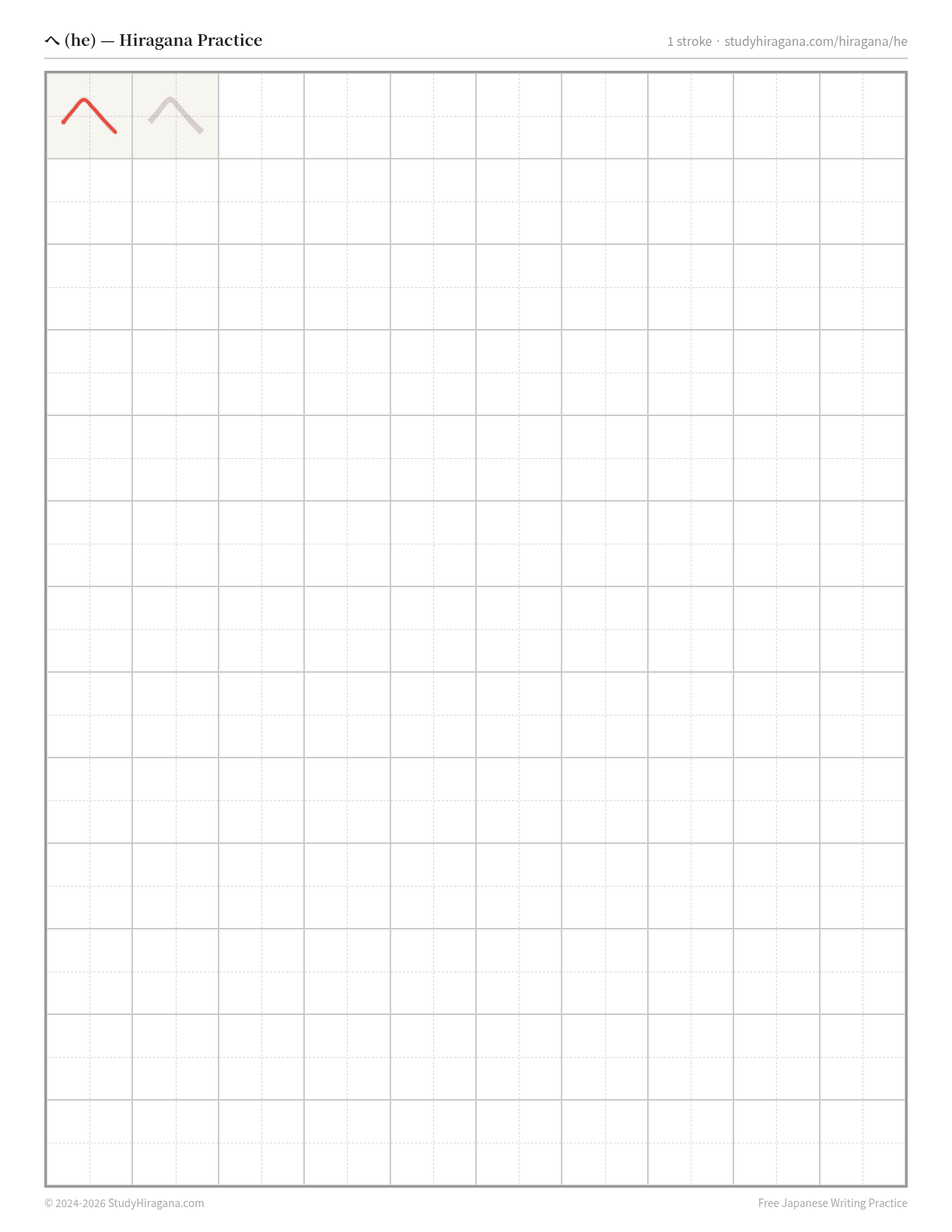
Print this worksheet to practice writing へ by hand — the top row shows the stroke order to trace, then fill the blank squares.
Lock it into memory
Reading is only half of it. Write the hiragana you’ve learned from memory in the trainer — the ones you struggle with come back sooner, until they stick.