e / エ
The fourth katakana vowel — a clean “eh” shaped exactly like the kanji 工. Three straight strokes, no curves.
Pronunciation
The character エ represents the vowel 'e', identical in pronunciation to hiragana え — like the 'e' in 'pet'. Common in loanwords starting with 'e' (energy, error, area, etc.).
エ carries the same “e” as hiragana え, with none of え's loops — just three straight lines. It heads up a wave of English-derived terms: エネルギー (energy), エリア (area), エレベーター (elevator), エアコン (air conditioner).
How to write エ
Trace エ on the canvas at the top of the page. Animated arrows show each stroke's direction; trace along them and the stroke fills in. Each numbered step below explains what that stroke does.
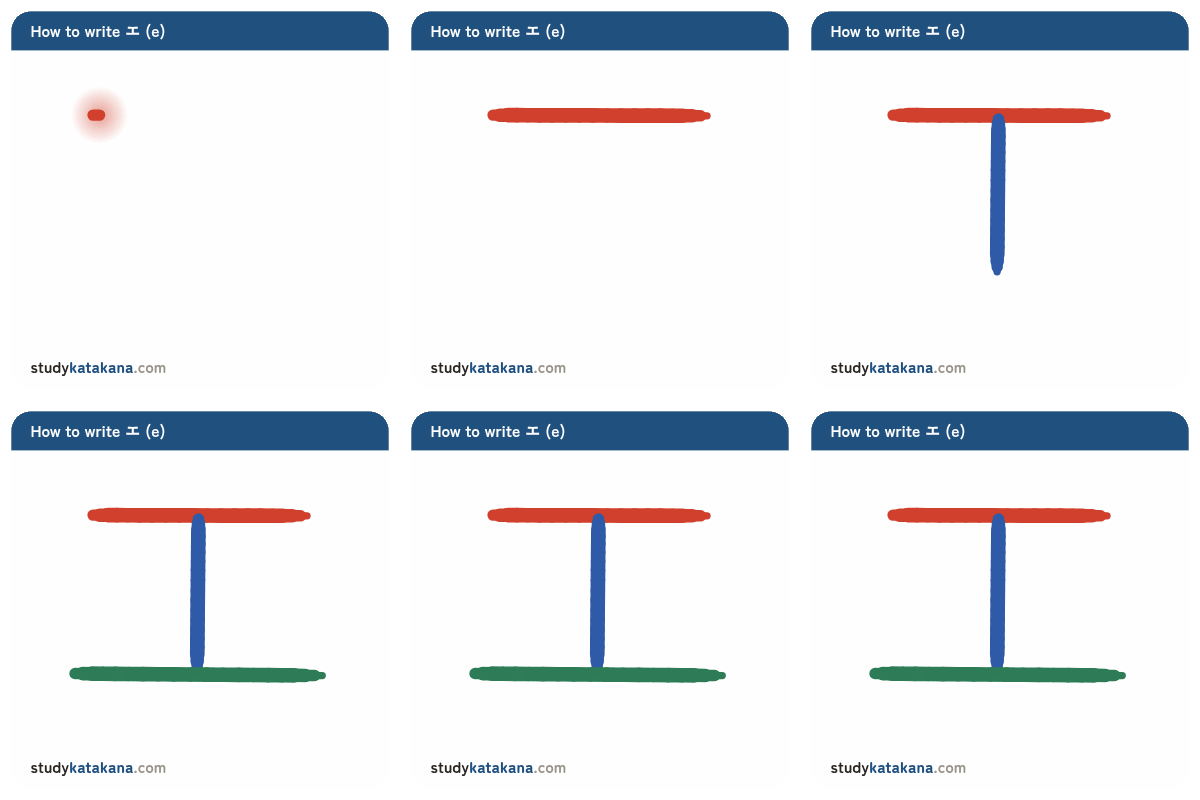
A horizontal stroke across the upper third, drawn left to right.
A vertical stroke straight down the centre, joining the top bar to the base.
A second horizontal stroke along the bottom, left to right and a touch wider. エ is the visual twin of the kanji 工.
Origin
Katakana エ was taken from the right-hand element of the kanji 江 (e) — “inlet” or “large river.” That element is 工, which is why エ and the kanji 工 look like twins: top bar, centre post, base.
Common words starting with エ
Printable practice sheet
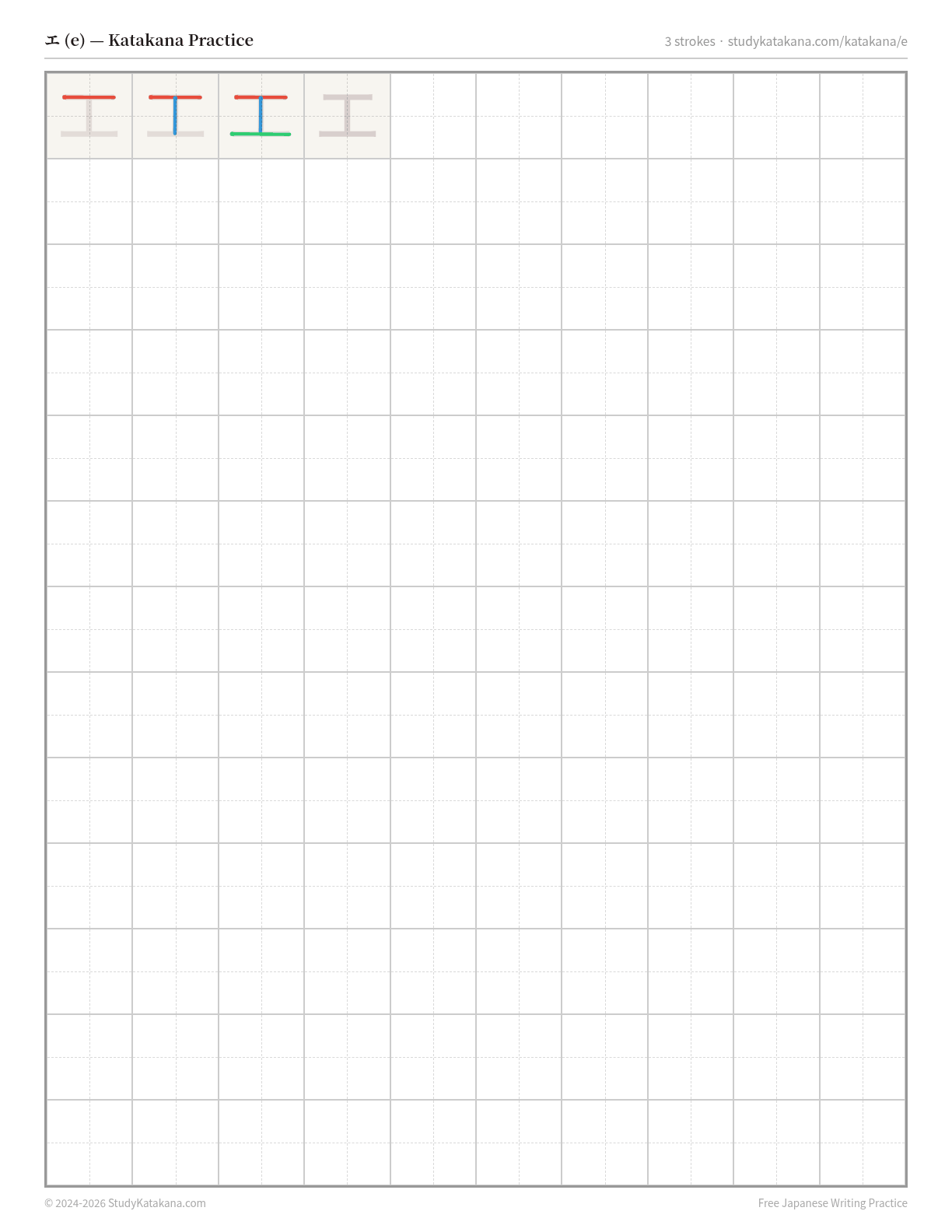
Print this worksheet to practice writing エ by hand — the top row shows the stroke order to trace, then fill the blank squares.
Lock it into memory
Reading is only half of it. Write the katakana you’ve learned from memory in the trainer — the ones you struggle with come back sooner, until they stick.