a / ア
The first katakana — and the front door to thousands of loanwords. The same “ah” as hiragana あ, written in two crisp, angular strokes.
Pronunciation
The character ア represents the vowel sound 'a', identical in pronunciation to the hiragana あ — like the 'a' in 'father'. Katakana characters like ア are used primarily for foreign loanwords, scientific terms, and stylistic emphasis. ア appears in countless loanwords from English and other languages.
ア is the katakana counterpart of hiragana あ — the very same vowel sound. Where hiragana flows in curves, katakana is built from sharp, straight lines made for fast reading. You'll meet ア at the start of countless loanwords: アメリカ (America), アイス (ice cream), アニメ (anime).
How to write ア
Trace ア on the canvas at the top of the page. Animated arrows show each stroke's direction; trace along them and the stroke fills in. Each numbered step below explains what that stroke does.
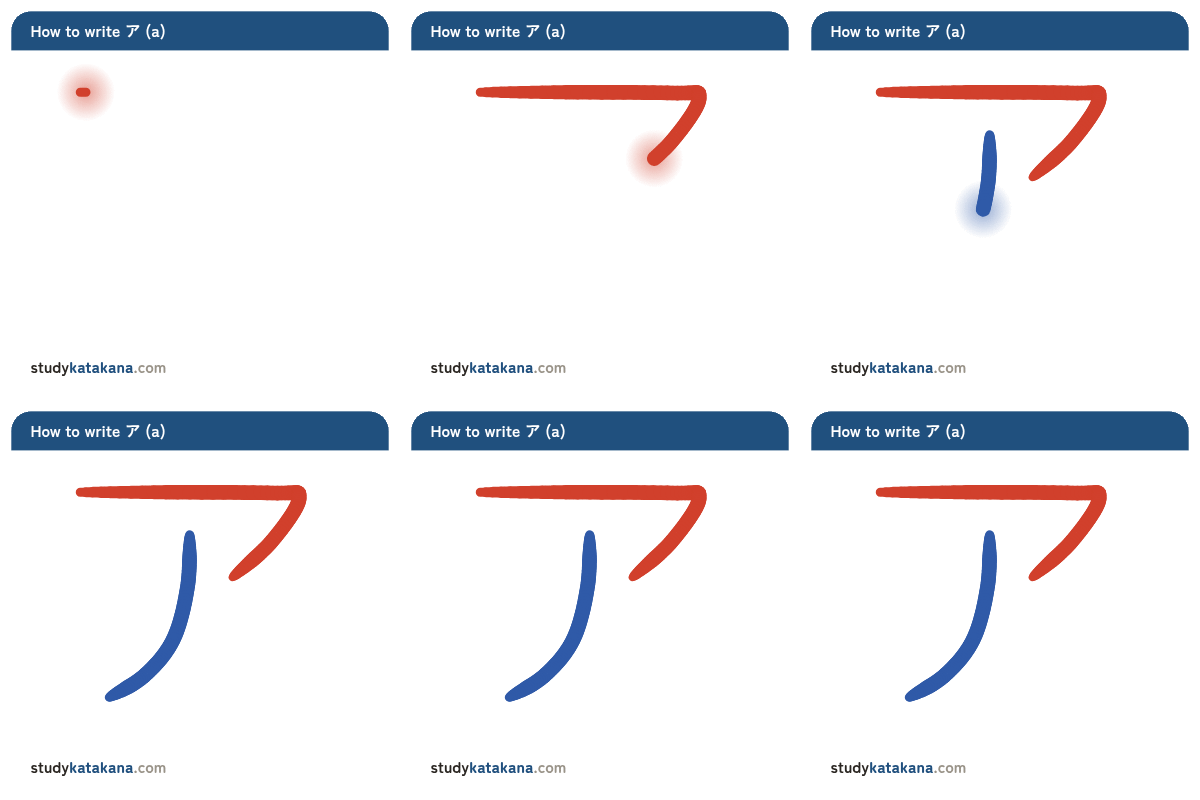
Start at the upper left and draw a line across to the right; at the far right, turn and sweep back down toward the centre. This single motion makes the top bar and right shoulder.
From the middle, draw a short diagonal down to the lower left — the inner leg that keeps ア from looking like a plain corner.
Origin
Katakana ア was clipped from a single fragment of the kanji 阿 (a) — its left-hand 阝 radical. Unlike hiragana, which rounds a whole character into cursive, katakana keeps just one piece: Buddhist monks in the 8th–9th centuries jotted these shorthand marks in the margins of texts as quick pronunciation guides.
Common words starting with ア
Printable practice sheet
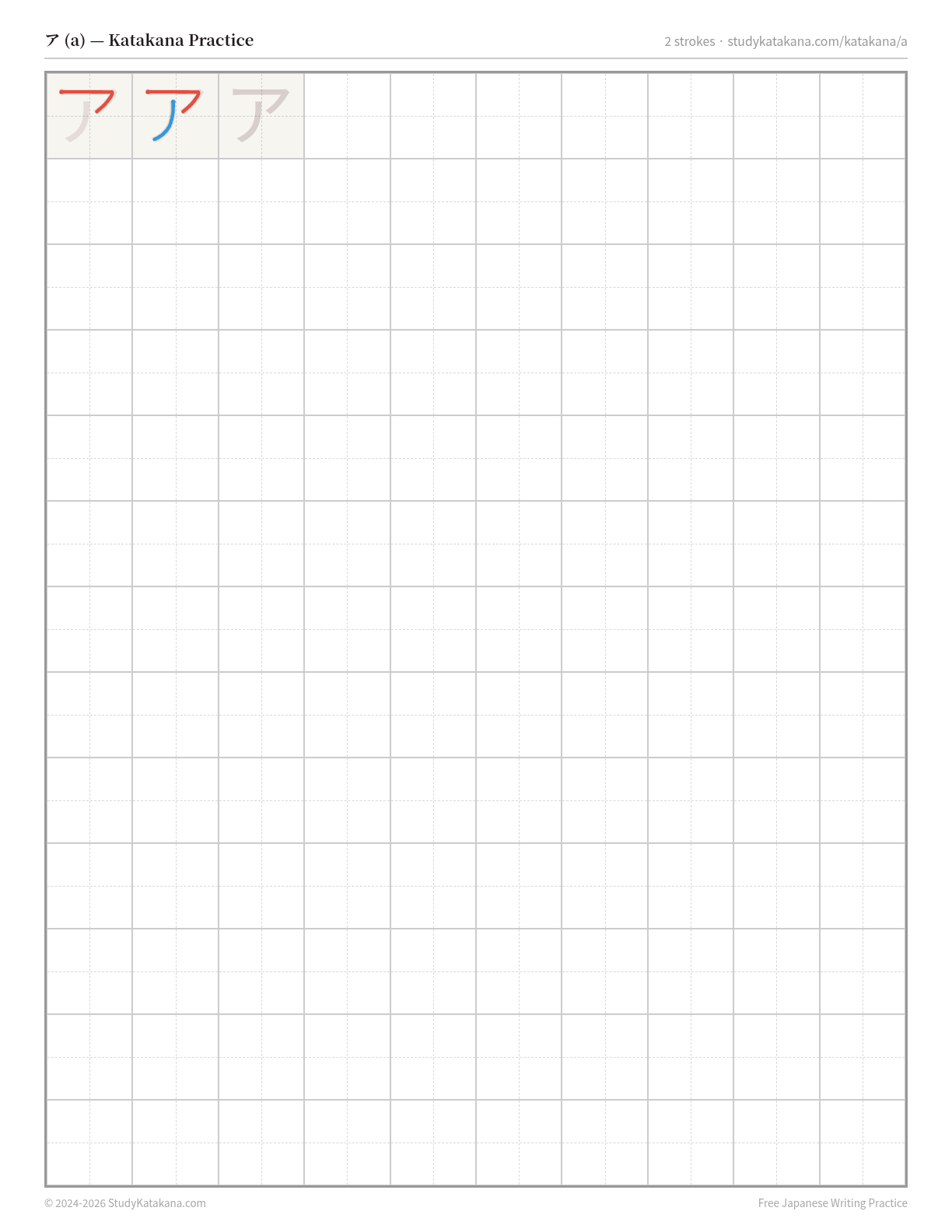
Print this worksheet to practice writing ア by hand — the top row shows the stroke order to trace, then fill the blank squares.
Lock it into memory
Reading is only half of it. Write the katakana you’ve learned from memory in the trainer — the ones you struggle with come back sooner, until they stick.