zu / ず
The middle of the Z row — す with two tiny ticks (゛) becomes 'zu'. Anchors water, maps, and the negative-form verb ending 〜ず.
Pronunciation
The character ず represents the syllable 'zu', a soft 'z' followed by 'u'. It is す with the dakuten that voices 's' to 'z'. Note that ず and づ are both pronounced 'zu' in modern Japanese — ず is the standard form used in most words.
ず is す (su) plus the dakuten ゛. It anchors 水 (mizu, "water"), 地図 (chizu, "map"), 鈴 (suzu, "bell"), 数字 (suuji, "numeral"), and the literary negative-form verb ending 〜ず ("not doing X"). Like じ, the romaji zu can map either to ず (this row, common) or to づ (D row, rare and mostly historical).
How to write ず
Trace ず on the canvas at the top of the page. Animated arrows show each stroke's direction; trace along them and the stroke fills in. Each numbered step below explains what that stroke does.

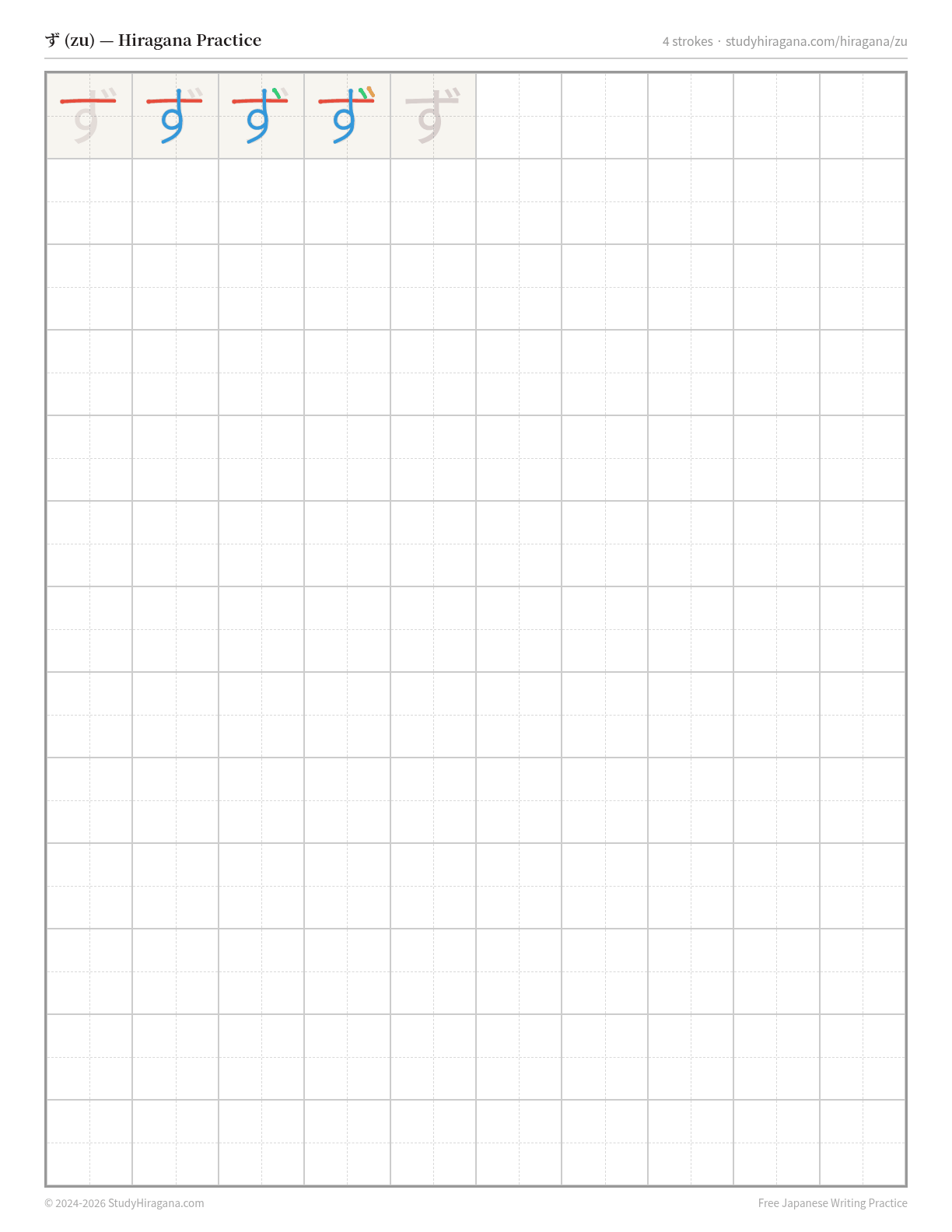
Write す exactly: stroke 1 a short horizontal at the top; stroke 2 a long flowing vertical that drops through stroke 1, loops around at the bottom into a small closed circle on the lower right, and exits with a small flick downward.
Add the dakuten (゛): two small tick marks at the upper right of the character. Strokes 3 and 4 are the two ticks, written quickly.
Origin
Hiragana ず shares its base shape with す, which evolved from the kanji 寸 (sun, a unit of length). The kanji's strokes flowed into the single looping body of す; the dakuten ゛ voiced /su/ into /zu/.
Common words starting with ず
Printable practice sheet
Print this worksheet to practice writing ず by hand — the top row shows the stroke order to trace, then fill the blank squares.
Lock it into memory
Reading is only half of it. Write the hiragana you’ve learned from memory in the trainer — the ones you struggle with come back sooner, until they stick.