za / ざ
The first of the Z row — さ with two tiny ticks (゛) becomes 'za'. Opens words for magazines, cushions, and volcanoes.
Pronunciation
The character ざ represents the syllable 'za', a soft 'z' followed by 'a' as in 'father'. It is さ with the dakuten — two small marks at the upper right that voice the consonant from 's' to 'z'. The Japanese 'z' is similar to English but slightly less buzzed.
ざ is さ (sa) plus the dakuten ゛ — two small tick marks at the upper right that voice the consonant. It anchors 雑誌 (zasshi, "magazine"), 座布団 (zabuton, "floor cushion"), 火山 (kazan, "volcano"), and 残念 (zannen, "too bad / regrettable"). Word-initial ざ is a crisp buzzing /za/; mid-word it stays /za/ — unlike the G row, the Z row doesn't have a nasal variant.
How to write ざ
Trace ざ on the canvas at the top of the page. Animated arrows show each stroke's direction; trace along them and the stroke fills in. Each numbered step below explains what that stroke does.
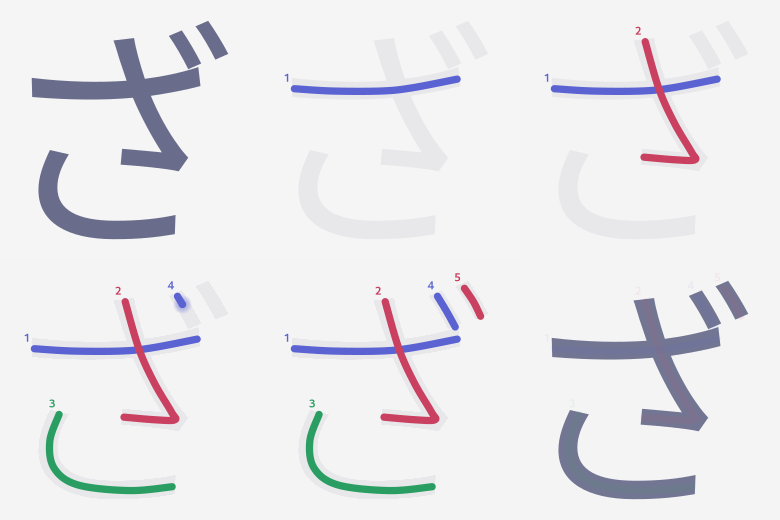
Write さ exactly: stroke 1 a short curving horizontal near the top; stroke 2 a longer curving stroke that crosses through stroke 1 and sweeps down and to the lower left; stroke 3 a small detached hook on the right side (modern fonts often join strokes 2 and 3, but they're traditionally separate).
Add the dakuten (゛): two small tick marks at the upper right of the character. Strokes 4 and 5 are the two ticks — quick, tiny, sitting clearly above the body.
Origin
Hiragana ざ shares its base shape with さ, which evolved from the kanji 左 (sa, "left"). The dakuten ゛ was added later as a diacritic to mark voicing; the same mark converts every S-row kana to its Z-row counterpart.
Common words starting with ざ
Printable practice sheet
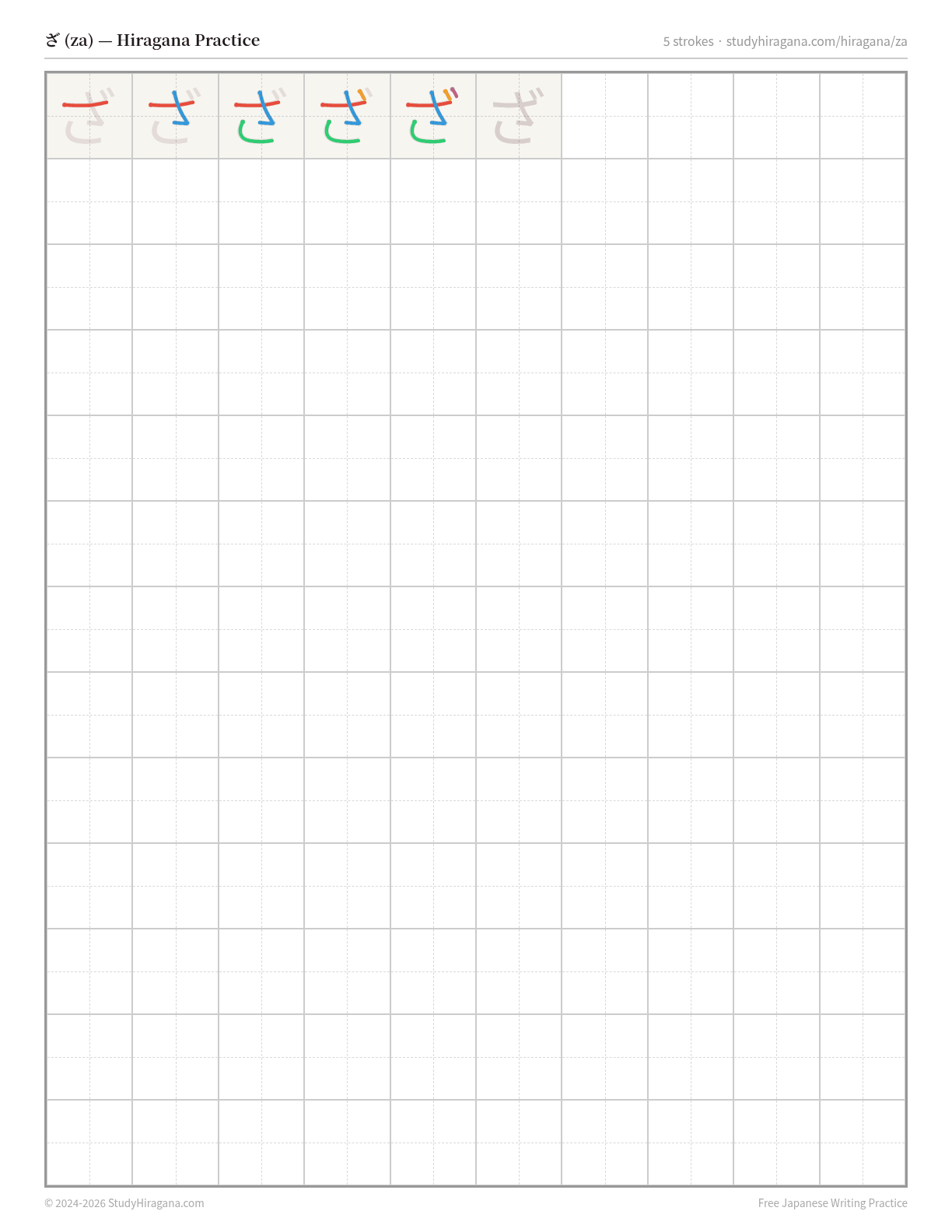
Print this worksheet to practice writing ざ by hand — the top row shows the stroke order to trace, then fill the blank squares.
Lock it into memory
Reading is only half of it. Write the hiragana you’ve learned from memory in the trainer — the ones you struggle with come back sooner, until they stick.