yu / ゆ
The middle of the Y row — two graceful strokes 'yu' that open words for dreams, snow, and hot water.
Pronunciation
The character ゆ represents the syllable 'yu', a soft 'y' followed by 'u' (with relaxed lips). Part of the や-row. The small version ゅ is used to form yōon syllables.
ゆ sits second in the Y row and packs into beloved everyday nouns — 夢 (dream), 雪 (snow), お湯 (hot water), 勇気 (courage). Its small version ゅ attaches to other characters to produce combined kana like きゅ (kyu), しゅ (shu), りゅ (ryu). The shape is closely related to め (me) — both have flowing looping bodies — but ゆ's body is more elongated and sits balanced over a long horizontal anchor.
How to write ゆ
Trace ゆ on the canvas at the top of the page. Animated arrows show each stroke's direction; trace along them and the stroke fills in. Each numbered step below explains what that stroke does.
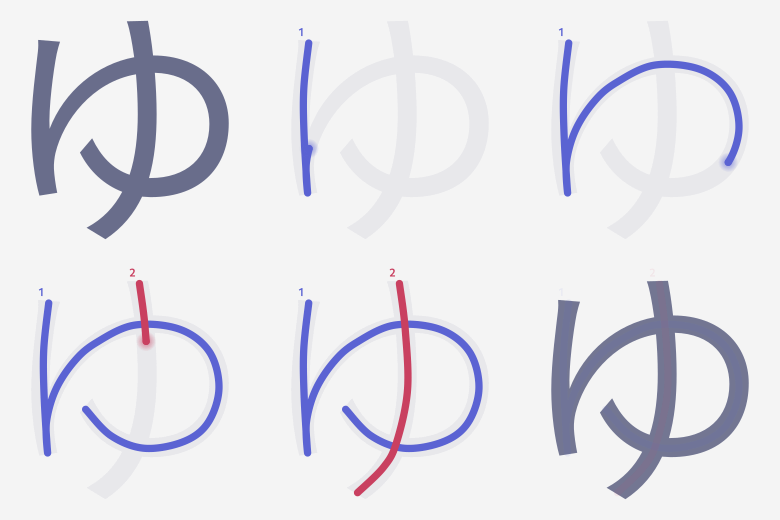
A long flowing stroke shaped like a sideways tear-drop. Start at the upper left, sweep down and around in a closed loop on the lower right, then exit with a small flick. Almost a comma or sideways P.
A long horizontal stroke crossing the body of stroke 1 near the middle — extends to the left and right, longer than the loop above it. This horizontal anchor is ゆ's defining feature, visually distinguishing it from め.
Origin
Hiragana ゆ traces back to the cursive form of the kanji 由 (yu) — meaning "reason" or "cause." The kanji's square outer body collapsed into the looping upper stroke; its central vertical preserves into the long horizontal anchor that defines ゆ today.
Common words starting with ゆ
Printable practice sheet
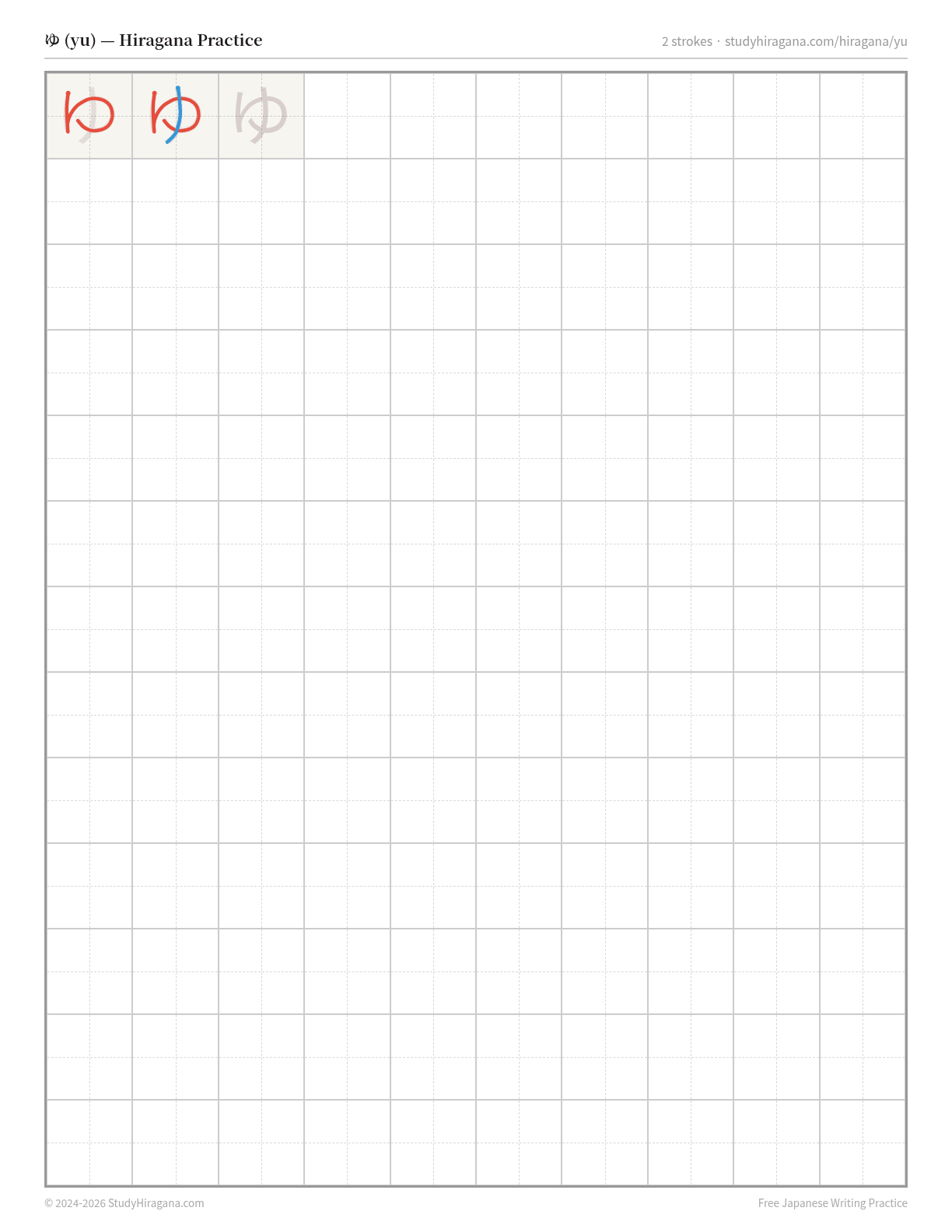
Print this worksheet to practice writing ゆ by hand — the top row shows the stroke order to trace, then fill the blank squares.
Lock it into memory
Reading is only half of it. Write the hiragana you’ve learned from memory in the trainer — the ones you struggle with come back sooner, until they stick.