ya / や
The first character of the Y row — a three-stroke 'ya' that anchors mountains, eights, and rooms.
Pronunciation
The character や represents the syllable 'ya', a soft 'y' sound followed by 'a' as in 'father'. It is the first character of the や-row. The small versions ゃ, ゅ, ょ are used to form compound 'yōon' syllables like きゃ (kya) and しゅ (shu).
や opens the Y row and shows up in the most-used family of nouns — 山 (mountain), 八 (eight), 部屋 (room), 屋 (-shop suffix in 本屋 "bookshop"). It also forms a small ゃ that attaches to other characters to produce combined kana like きゃ (kya), しゃ (sha), ちゃ (cha) — a critical building block you'll meet in the next chapter. Three strokes; flowing and slightly busy.
How to write や
Trace や on the canvas at the top of the page. Animated arrows show each stroke's direction; trace along them and the stroke fills in. Each numbered step below explains what that stroke does.

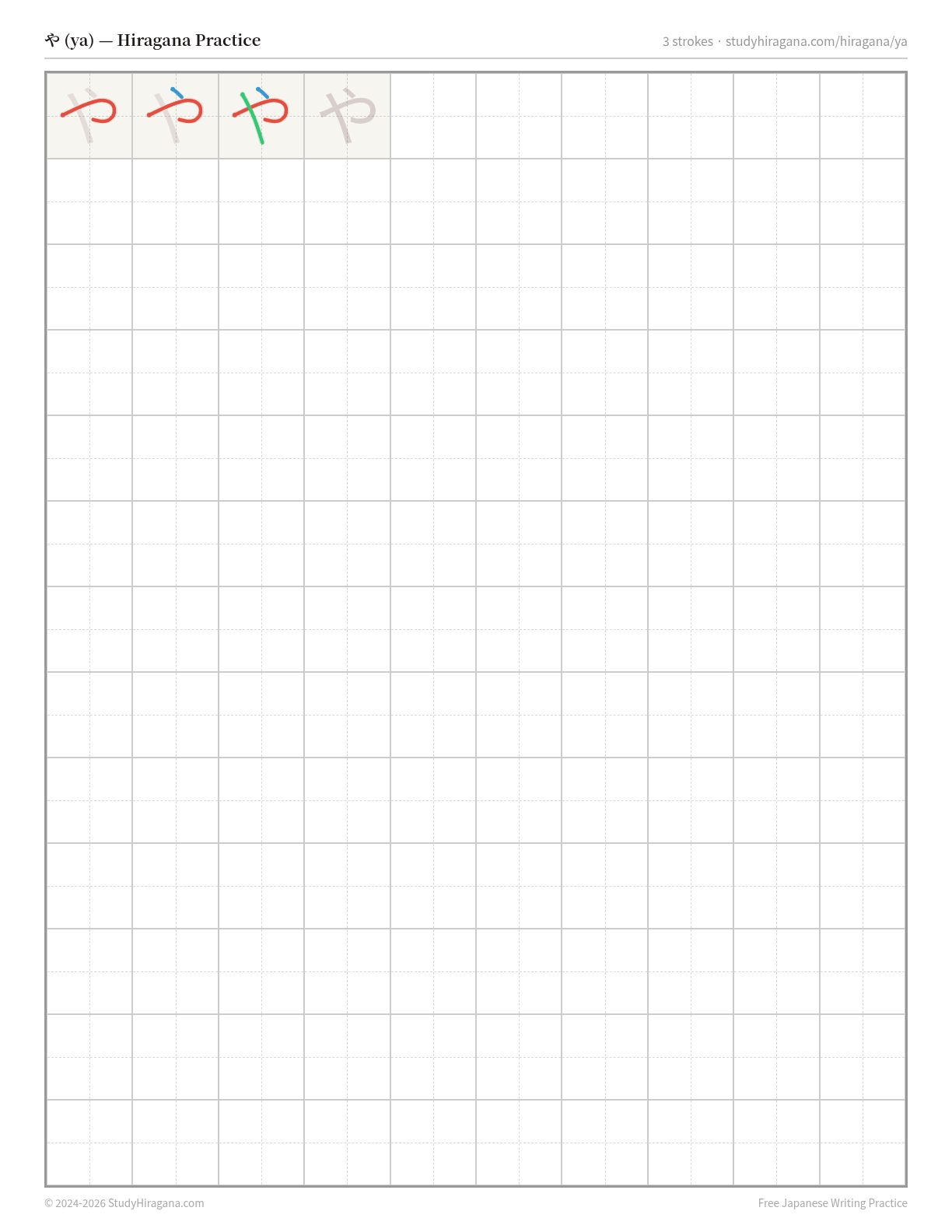
A short, slightly slanted horizontal stroke at the upper middle — quick, written left to right.
A long flowing stroke that starts where stroke 1 ends, drops down through the centre, sweeps around at the bottom in an open curl, and exits with a small flick on the lower right.
A short detached slanted stroke on the upper right — a small accent mark added after the looping body is finished. This tiny mark is what distinguishes や from や's near-twins.
Origin
Hiragana や evolved from the cursive form of the kanji 也 (ya) — meaning "also" or "as well." The kanji's two main strokes flowed together into the body of や; the small detached accent on the upper right preserves what's left of its top tick.
Common words starting with や
Printable practice sheet
Print this worksheet to practice writing や by hand — the top row shows the stroke order to trace, then fill the blank squares.
Lock it into memory
Reading is only half of it. Write the hiragana you’ve learned from memory in the trainer — the ones you struggle with come back sooner, until they stick.