wo / を
The second of the W row — three strokes 'wo' (pronounced 'o') that exist almost solely as the direct-object particle.
Pronunciation
The character を represents the syllable 'wo', though it is pronounced essentially identically to 'o' (the same as お) in modern Japanese. Its sole modern use is as the direct-object particle, marking what a verb acts upon — one of the most common particles in the language. You'll never see を inside ordinary vocabulary words; it appears only as a grammatical particle.
を is one of the most-used characters in written Japanese — but it appears almost exclusively as the direct-object particle, the small grammatical marker that says "this is what the verb is acting on" (パンを食べる, "eat bread"; 本を読む, "read a book"). Despite its romaji wo, modern speakers pronounce it identically to お — o. You will essentially never see を inside ordinary vocabulary words; if you see を in a sentence, it's the particle.
How to write を
Trace を on the canvas at the top of the page. Animated arrows show each stroke's direction; trace along them and the stroke fills in. Each numbered step below explains what that stroke does.

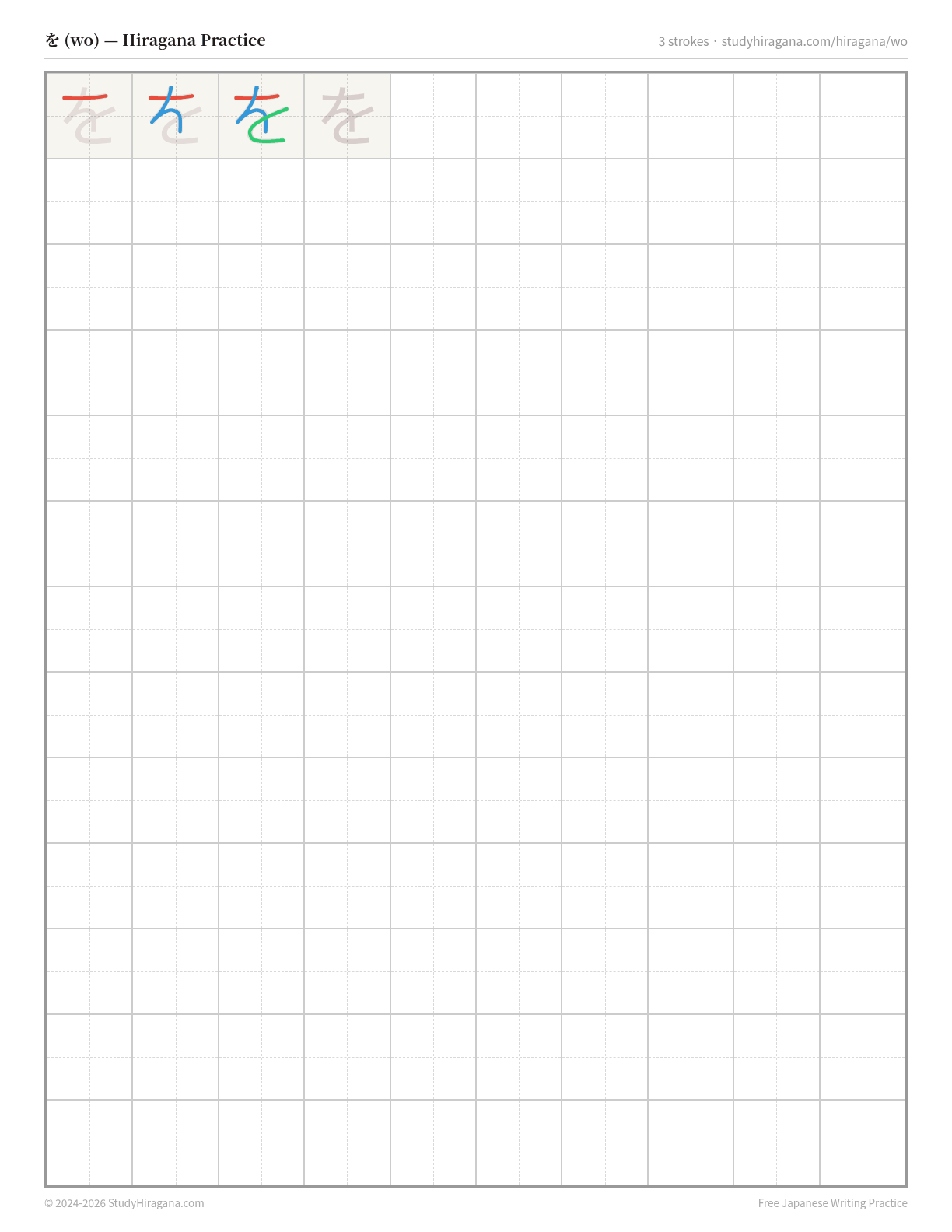
A short horizontal stroke at the upper middle — quick, left to right.
A long diagonal stroke that crosses through stroke 1 and sweeps down to the lower left.
A long flowing stroke that begins at the upper right, crosses through the middle of the character, sweeps down and to the right, and ends with a small upward hook on the lower right. The crossed-diagonal-with-flowing-tail shape is を's signature.
Origin
Hiragana を traces back to the cursive form of the kanji 遠 (en / tooi) — meaning "far" or "distant." The kanji's complex layout collapsed into the three strokes we write today, preserving the upper accent, the central crossing, and the flowing right-side tail.
Common words starting with を
Printable practice sheet
Print this worksheet to practice writing を by hand — the top row shows the stroke order to trace, then fill the blank squares.
Lock it into memory
Reading is only half of it. Write the hiragana you’ve learned from memory in the trainer — the ones you struggle with come back sooner, until they stick.