n / ん
The closer of the chart — a single flowing stroke 'n' that's the only standalone consonant in hiragana, appearing at the end of countless words.
Pronunciation
The character ん represents the syllabic nasal 'n' — the only consonant in Japanese that can stand alone as a full syllable without a vowel. It can sound like 'n', 'm', or 'ng' depending on what follows: closer to 'm' before 'p', 'b', or 'm' (e.g., さんま 'samma'), closer to 'ng' before 'k' or 'g' (e.g., りんご 'ringo'), and 'n' elsewhere. ん never starts a word — it always ends or appears mid-word.
ん is the only standalone consonant in hiragana — the syllabic nasal. It can sound like n, m, or ng depending on what follows: closer to m before p, b, m (さんま samma); closer to ng before k, g (りんご ringo); and n elsewhere. ん never starts a word — it always closes or appears mid-word. You'll see it everywhere: 本 (hon, "book"), 円 (en, "yen"), さん (the honorific suffix), and the negative ending 〜ません. One stroke; one of the easiest to write and one of the most-used characters in the language.
How to write ん
Trace ん on the canvas at the top of the page. Animated arrows show each stroke's direction; trace along them and the stroke fills in. Each numbered step below explains what that stroke does.

A single flowing stroke. Begin in the upper left with a short downward dash, sweep down to the lower middle, then curve upward and to the right in a smooth arc that rises toward the upper right and ends with a small inward hook. The shape resembles a small lowercase 'n' or a flowing wave.
Origin
Hiragana ん derives from the cursive form of the kanji 无 (mu) — meaning "nothing" or "none." The kanji's strokes flowed together into the single sweeping curve we write today; ん was a relatively late addition to the kana set, codified as a distinct character only in the late 19th century.
Common words starting with ん
Printable practice sheet
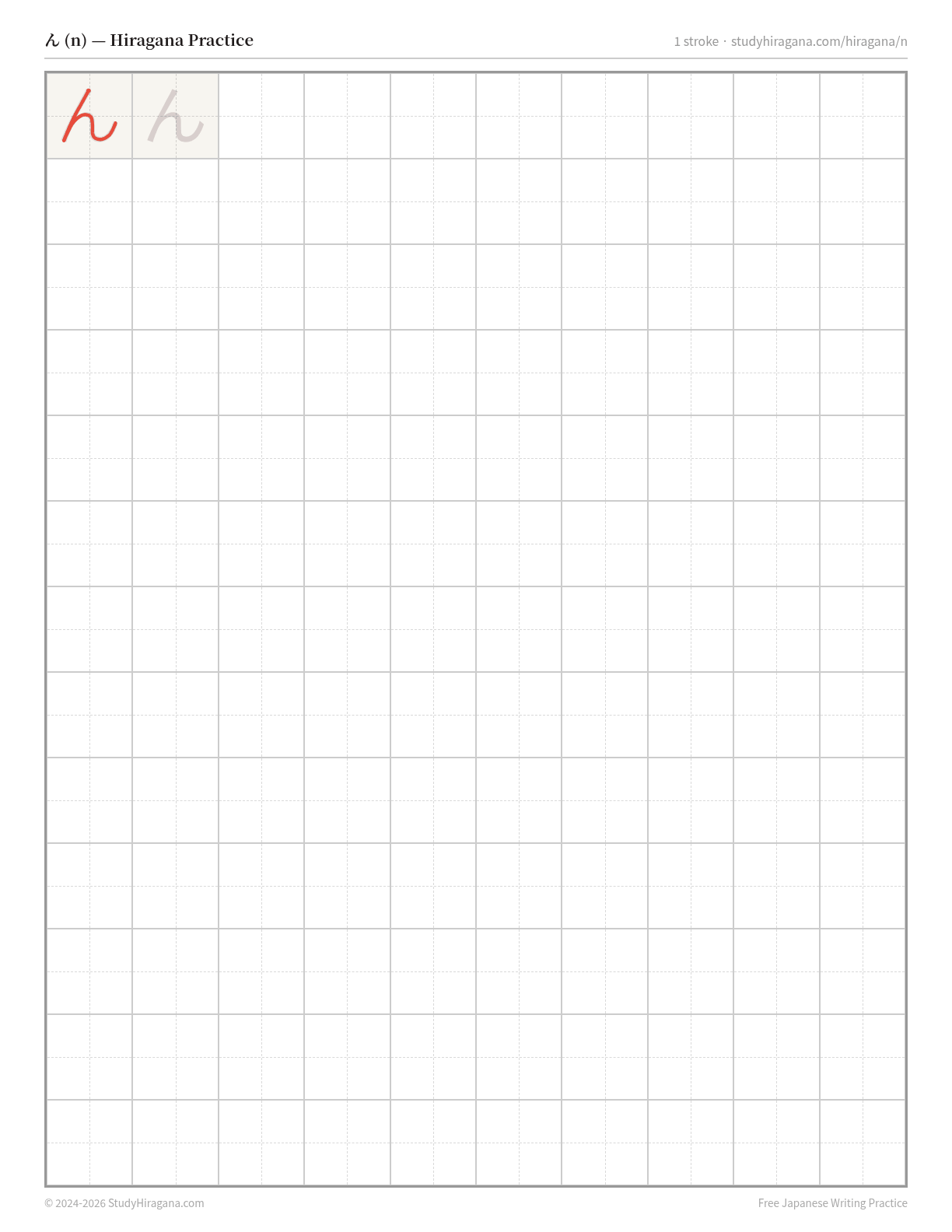
Print this worksheet to practice writing ん by hand — the top row shows the stroke order to trace, then fill the blank squares.
Lock it into memory
Reading is only half of it. Write the hiragana you’ve learned from memory in the trainer — the ones you struggle with come back sooner, until they stick.