to / と
The last of the T row — two strokes 'to' that pack into words for time, friends, doors, and one of the most-used particles in the language.
Pronunciation
The character と represents the syllable 'to', a hard 't' followed by 'o'. Part of the た-row.
と closes the T row and is one of the most-used hiragana you'll meet. As a particle, と means "and" or marks quoted speech (Aさんと話す, "to speak with A"). It also anchors 時 (time), 友 (friend), 戸 (door), and 十 (ten). Two strokes — a tiny dot and a long curving line — distinctive and easy to draw.
How to write と
Trace と on the canvas at the top of the page. Animated arrows show each stroke's direction; trace along them and the stroke fills in. Each numbered step below explains what that stroke does.

A tiny dot or short slanted mark near the upper middle — quick, almost a flick.
A long flowing stroke that starts on the left, sweeps down and to the right with a gentle curve, then loops back up and around at the bottom right with a small hook. The bottom hook is と's defining feature — it visually separates と from つ and く.
Origin
Hiragana と comes from the cursive form of the kanji 止 (to as a historic reading) — meaning "to stop." The kanji's small upper dot and long curving lower body collapsed into the two strokes of と, preserving the top accent and the lower hook.
Common words starting with と
Printable practice sheet
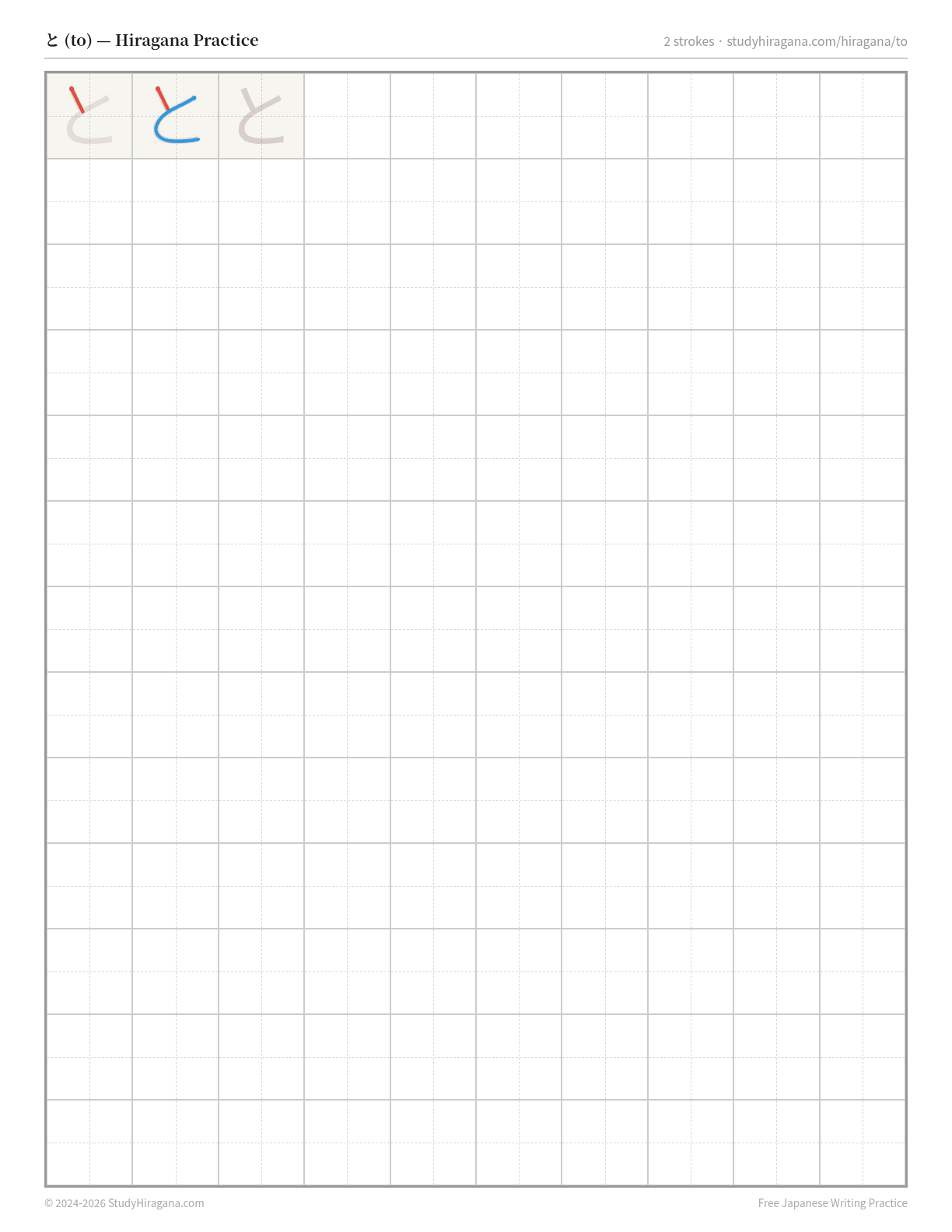
Print this worksheet to practice writing と by hand — the top row shows the stroke order to trace, then fill the blank squares.
Lock it into memory
Reading is only half of it. Write the hiragana you’ve learned from memory in the trainer — the ones you struggle with come back sooner, until they stick.