chi / ち
The second of the T row — a flowing 'chi' (not 'ti') that opens words for blood, fathers, and small things.
Pronunciation
The character ち represents the syllable 'chi', a soft 'ch' sound followed by 'i'. Note: it is NOT pronounced 'ti' — there is no 'ti' sound in standard Japanese; the 'ch' sound always replaces it in this position. Part of the た-row. Take care: ち looks similar to さ but the curl is on the OPPOSITE side.
ち is the second irregular romanisation in the chart (after し): the consonant softens to ch before the い vowel — so we write chi, not ti. It appears in 血 (blood), 父 (father), 小さい (small) and the high-frequency particle ち in compounds. Two strokes; small but distinctive.
How to write ち
Trace ち on the canvas at the top of the page. Animated arrows show each stroke's direction; trace along them and the stroke fills in. Each numbered step below explains what that stroke does.
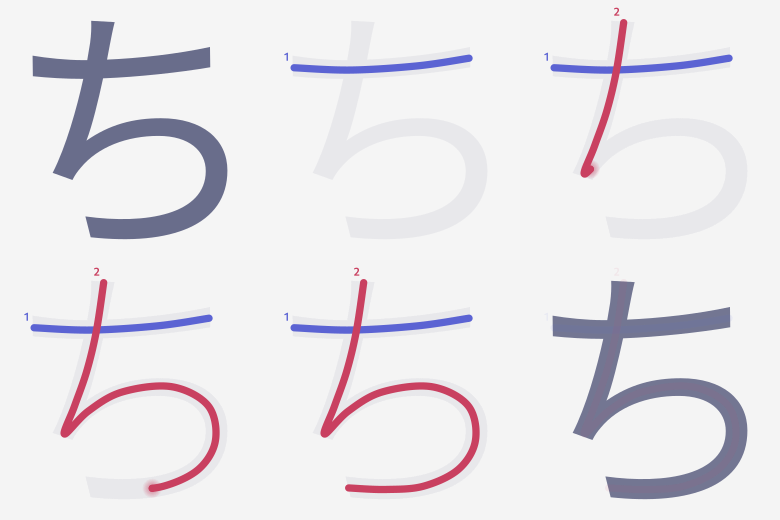
A short horizontal stroke at the top — slightly slanted, written left to right.
A long flowing stroke that begins at the upper right, sweeps down past the top horizontal, curves around the lower middle with a sharp turn, and ends with a small flick on the lower left. This is what gives ち its forward-leaning, almost number-5-like silhouette.
Origin
Hiragana ち traces back to the cursive form of the kanji 知 (chi) — meaning "to know." The kanji's right radical (口, mouth) and the slashing left arrow flowed together into the two strokes of ち, preserving the top dash and the sweeping turn but compressing everything else.
Common words starting with ち
Printable practice sheet
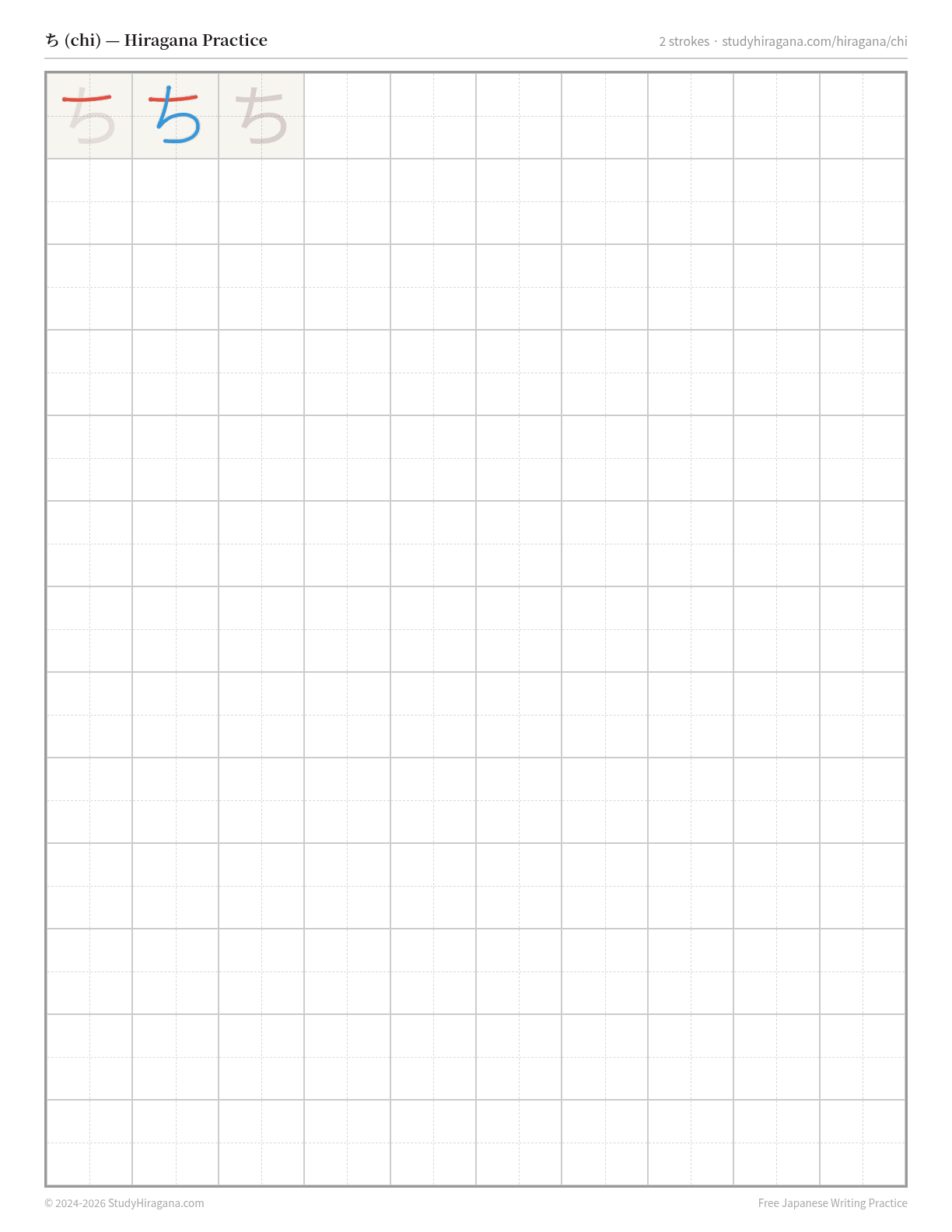
Print this worksheet to practice writing ち by hand — the top row shows the stroke order to trace, then fill the blank squares.
Lock it into memory
Reading is only half of it. Write the hiragana you’ve learned from memory in the trainer — the ones you struggle with come back sooner, until they stick.