ri / り
The second of the R row — two parallel strokes 'ri' that open words for science, squirrels, birds, and the polite negative ending.
Pronunciation
The character り represents the syllable 'ri', a soft Japanese 'r' followed by 'i'. Part of the ら-row. The Japanese 'r' here is a single tap of the tongue — closer to a soft 'd' or 'l' sound than the English 'r'.
り sits second in the R row and packs into many beginner words — 鳥 (bird), 力 (power, as ちから ends in り compound forms), 理科 (science). It also appears in the polite verb endings 〜ました/〜ません that mark past and negative present tenses (食べました, "ate"). Two short parallel strokes — one of the simpler hiragana to write.
How to write り
Trace り on the canvas at the top of the page. Animated arrows show each stroke's direction; trace along them and the stroke fills in. Each numbered step below explains what that stroke does.

A short curving stroke on the left — drops from the upper left down with a faint inward curve, ending with a small flick at the lower right.
A longer parallel stroke on the right — drops from the upper right down with the same gentle curve, slightly taller than stroke 1. The two strokes lean slightly toward each other and never touch.
Origin
Hiragana り traces back to the cursive form of the kanji 利 (ri) — meaning "profit" or "benefit." The kanji's left radical (禾, grain) compressed into the small left stroke; its right radical (刂, blade) preserved as the longer right stroke that defines り today.
Common words starting with り
Printable practice sheet
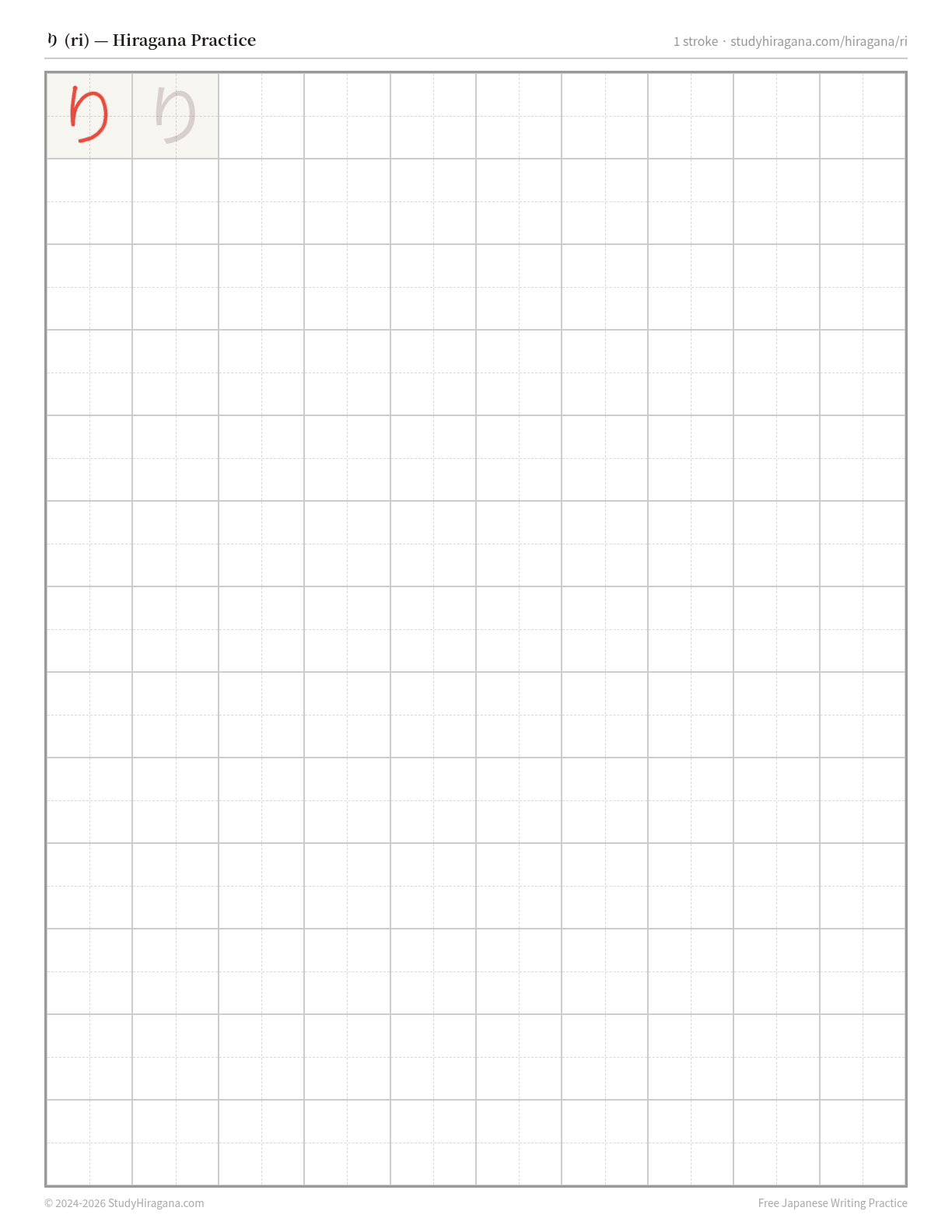
Print this worksheet to practice writing り by hand — the top row shows the stroke order to trace, then fill the blank squares.
Lock it into memory
Reading is only half of it. Write the hiragana you’ve learned from memory in the trainer — the ones you struggle with come back sooner, until they stick.