re / れ
The fourth of the R row — two strokes 'れ' that close out the polite verb stem and stand on their own as 'that' (over there).
Pronunciation
The character れ represents the syllable 're', a soft Japanese 'r' followed by 'e' as in 'pet'. Part of the ら-row. Take care: れ shares its left side with ね and わ — れ has no loop on the right (compare ね's closed loop and わ's curving sweep).
れ anchors the R row and shows up in many essential words — 練習 (practice), 歴史 (history), 連れる (to take along). It also appears in the demonstrative これ (this one) and あれ (that one), and as the noun-forming suffix 〜られる (potential / passive forms of verbs). Two strokes: a short left vertical anchor and a flowing right-side body very similar to ね.
How to write れ
Trace れ on the canvas at the top of the page. Animated arrows show each stroke's direction; trace along them and the stroke fills in. Each numbered step below explains what that stroke does.
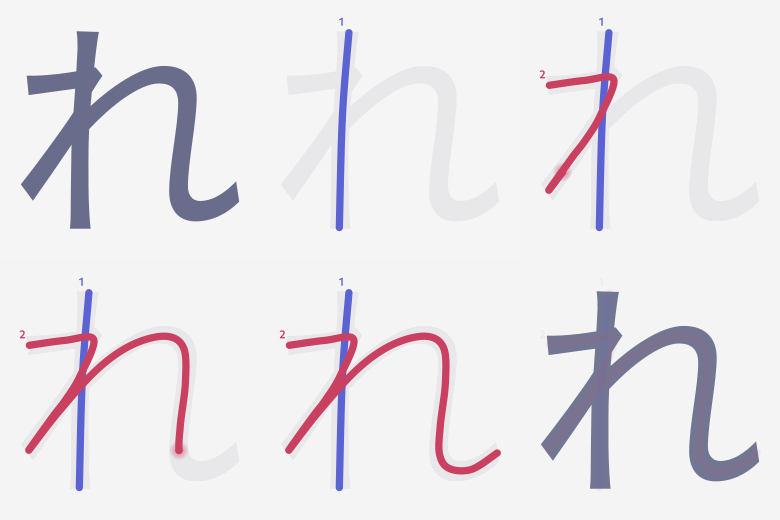
A short vertical stroke on the left — straight or with a faint inward curve. Same opening as ね.
A long flowing stroke that begins at the upper right, drops down past the bottom of the first vertical, then sweeps to the upper right with a gentle hook and a small flick. Unlike ね, れ does NOT form a closed loop at the bottom — it just hooks out and ends. That's the visual difference between れ and ね.
Origin
Hiragana れ evolved from the cursive form of the kanji 礼 (rei) — meaning "courtesy" or "manners." The kanji's left altar radical (示) compressed into the small left vertical; the right radical (乚) preserved as the long flowing right-side body of れ.
Common words starting with れ
Printable practice sheet
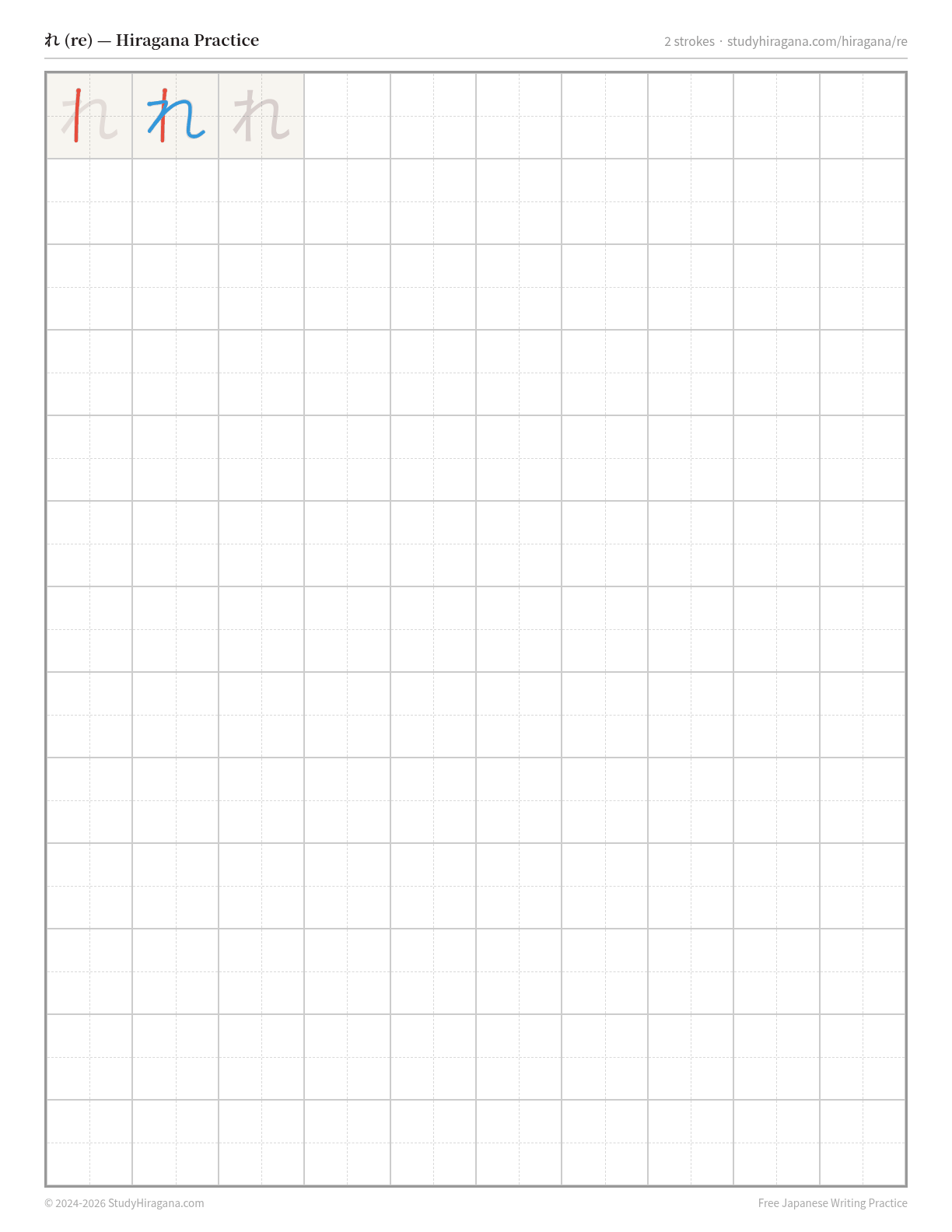
Print this worksheet to practice writing れ by hand — the top row shows the stroke order to trace, then fill the blank squares.
Lock it into memory
Reading is only half of it. Write the hiragana you’ve learned from memory in the trainer — the ones you struggle with come back sooner, until they stick.