o / お
The last of the five vowels — closes the あいうえお sequence with a steady 'o' that holds without gliding.
Pronunciation
The character お represents the vowel 'o', pronounced like the 'o' in 'oh' or the Spanish 'o'. It is one of the five basic Japanese vowels. The sound is short and clean — extended in writing by adding う (おう, often heard as a long 'oh' sound).
お closes the vowel sequence あいうえお and anchors the お-row (こ, そ, と, の, ほ…). It often pairs with う to mark long vowels (ありがとう, ほう, おう); when you see お followed by う, treat it as a single sustained 'o', not two distinct vowels.
How to write お
Trace お on the canvas at the top of the page. Animated arrows show each stroke's direction; trace along them and the stroke fills in. Each numbered step below explains what that stroke does.
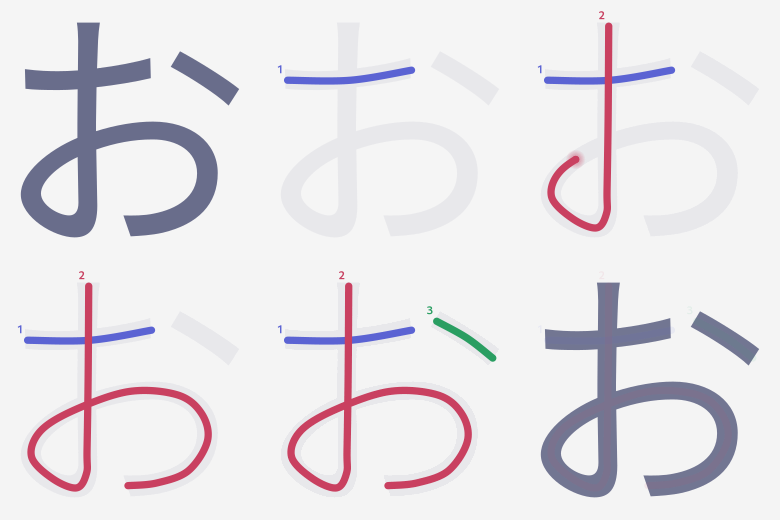
A short horizontal line near the top. Draw left to right — anchors the upper third of the character.
A long vertical line that crosses the first stroke and curves around at the bottom, forming a closed loop on the lower left.
A small detached mark on the upper right — a short curving stroke that adds お's distinctive 'tail'. This is what visually distinguishes お from あ.
Origin
Hiragana お derives from the cursive form of the kanji 於 (o) — “at” or “in.” Its three strokes preserve the kanji's body-plus-detached-mark structure: the small upper-right flick is what visually separates お from its near-twin あ.
Common words starting with お
Printable practice sheet
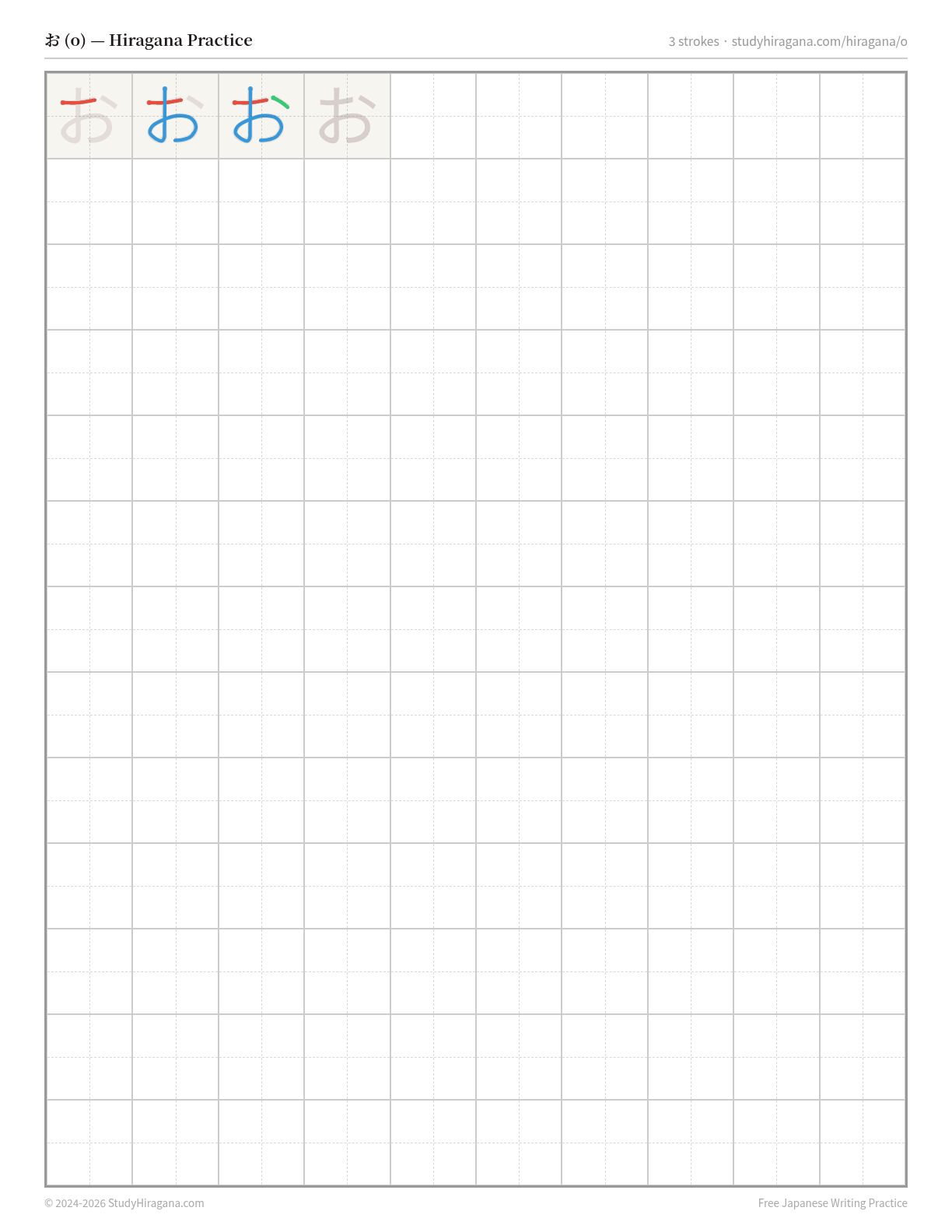
Print this worksheet to practice writing お by hand — the top row shows the stroke order to trace, then fill the blank squares.
Lock it into memory
Reading is only half of it. Write the hiragana you’ve learned from memory in the trainer — the ones you struggle with come back sooner, until they stick.