wo / ヲ
The rare W-row katakana — “wo,” pronounced “o.” You'll seldom meet it: the を particle is almost always written in hiragana.
Pronunciation
The character ヲ historically represented 'wo' but is essentially never used in modern Japanese. The hiragana を serves as the direct-object particle, and particles in Japanese are written in hiragana, not katakana. ヲ appears today only in archaic texts, stylistic flourishes, and a few proper nouns.
ヲ matches hiragana を — and like を, it's pronounced simply “o.” In modern Japanese it survives only as the object-marking particle, which is normally written を in hiragana, so katakana ヲ is genuinely rare. You'll see it mostly in older texts, stylised signage, or telegrams — almost never in loanwords.
How to write ヲ
Trace ヲ on the canvas at the top of the page. Animated arrows show each stroke's direction; trace along them and the stroke fills in. Each numbered step below explains what that stroke does.
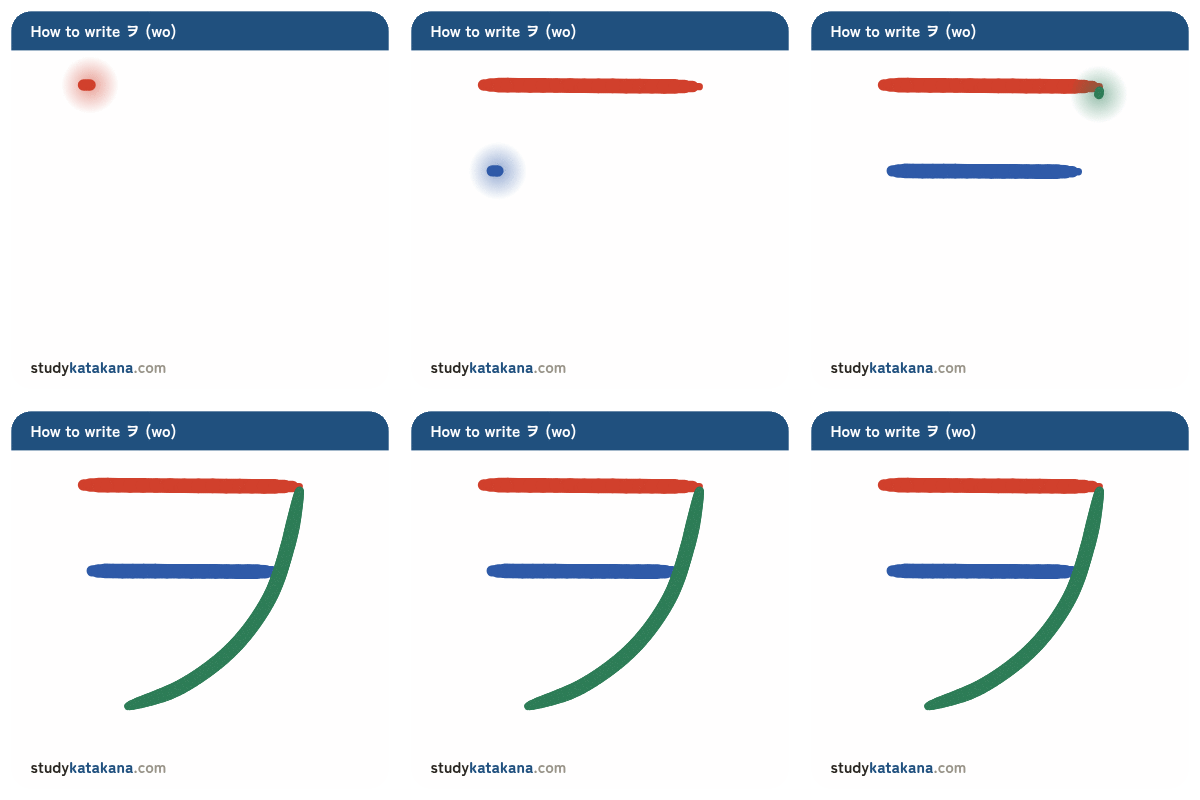
A horizontal stroke across the top, left to right.
A second horizontal stroke below it, left to right.
A stroke from the right end sweeping down and to the left — the curved tail of ヲ.
Origin
Katakana ヲ comes from the kanji 乎 (wo, a classical exclamatory particle). It has faded from everyday use along with the distinct “wo” sound, which merged into “o” centuries ago.
Common words starting with ヲ
Printable practice sheet
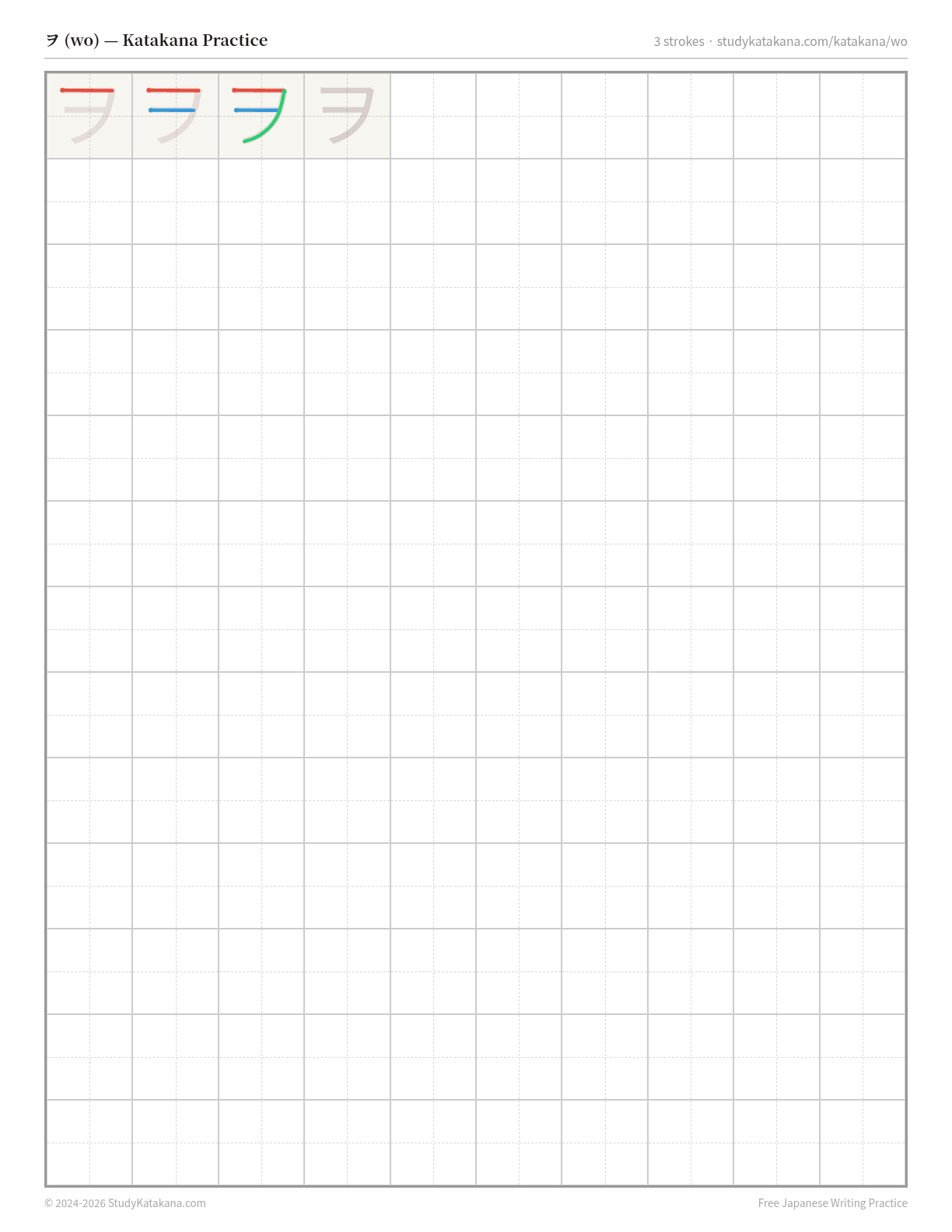
Print this worksheet to practice writing ヲ by hand — the top row shows the stroke order to trace, then fill the blank squares.
Lock it into memory
Reading is only half of it. Write the katakana you’ve learned from memory in the trainer — the ones you struggle with come back sooner, until they stick.