n / ン
The standalone “n” — the only katakana for a lone consonant, and one of the most common characters you'll ever read. Watch it against ソ.
Pronunciation
The character ン represents the syllabic nasal 'n' — the only consonant in katakana that can stand alone as a full syllable. It can sound like 'n', 'm', or 'ng' depending on what follows. Take care: ン resembles ソ (so) — but ン's strokes go from lower left to upper right, while ソ's go from upper right to lower left. Extremely common as the ending or middle of loanwords.
ン matches hiragana ん — a standalone “n,” the only kana that isn't a full consonant-plus-vowel syllable. It never starts a word, but it ends a huge share of loanwords: パン (bread), ペン (pen), ワイン (wine), レストラン (restaurant). Its flat opening mark and upward sweep are the mirror of ソ.
How to write ン
Trace ン on the canvas at the top of the page. Animated arrows show each stroke's direction; trace along them and the stroke fills in. Each numbered step below explains what that stroke does.
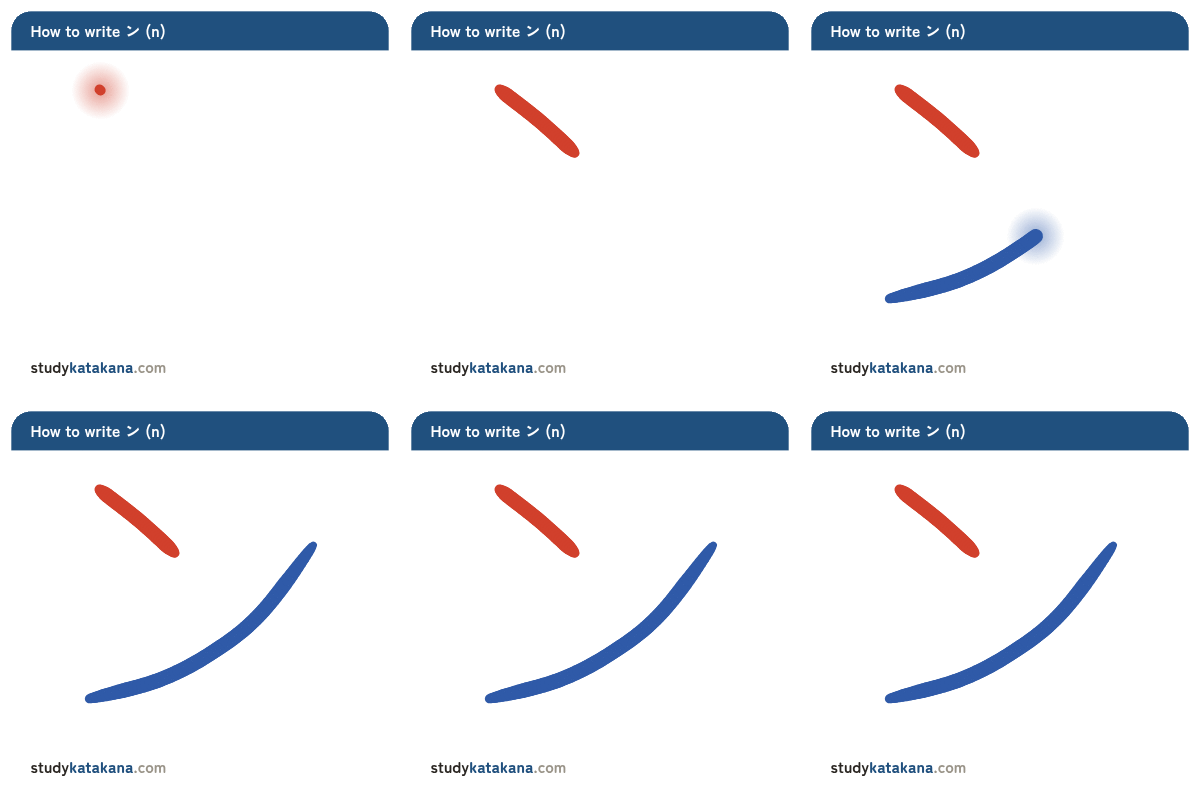
A short mark near the top left, ticking down to the right — flatter than ソ's steep opening mark.
A long stroke sweeping UP from the lower left to the upper right. That upward sweep is the tell: ン rises, while look-alike ソ sweeps down.
Origin
Katakana ン's origin is debated. It's commonly traced to the first strokes of 尓 (a form of 爾, ni), though some scholars hold that ン didn't descend from any single kanji at all — a fitting mystery for the one kana that stands for a lone consonant.
Common words starting with ン
Printable practice sheet
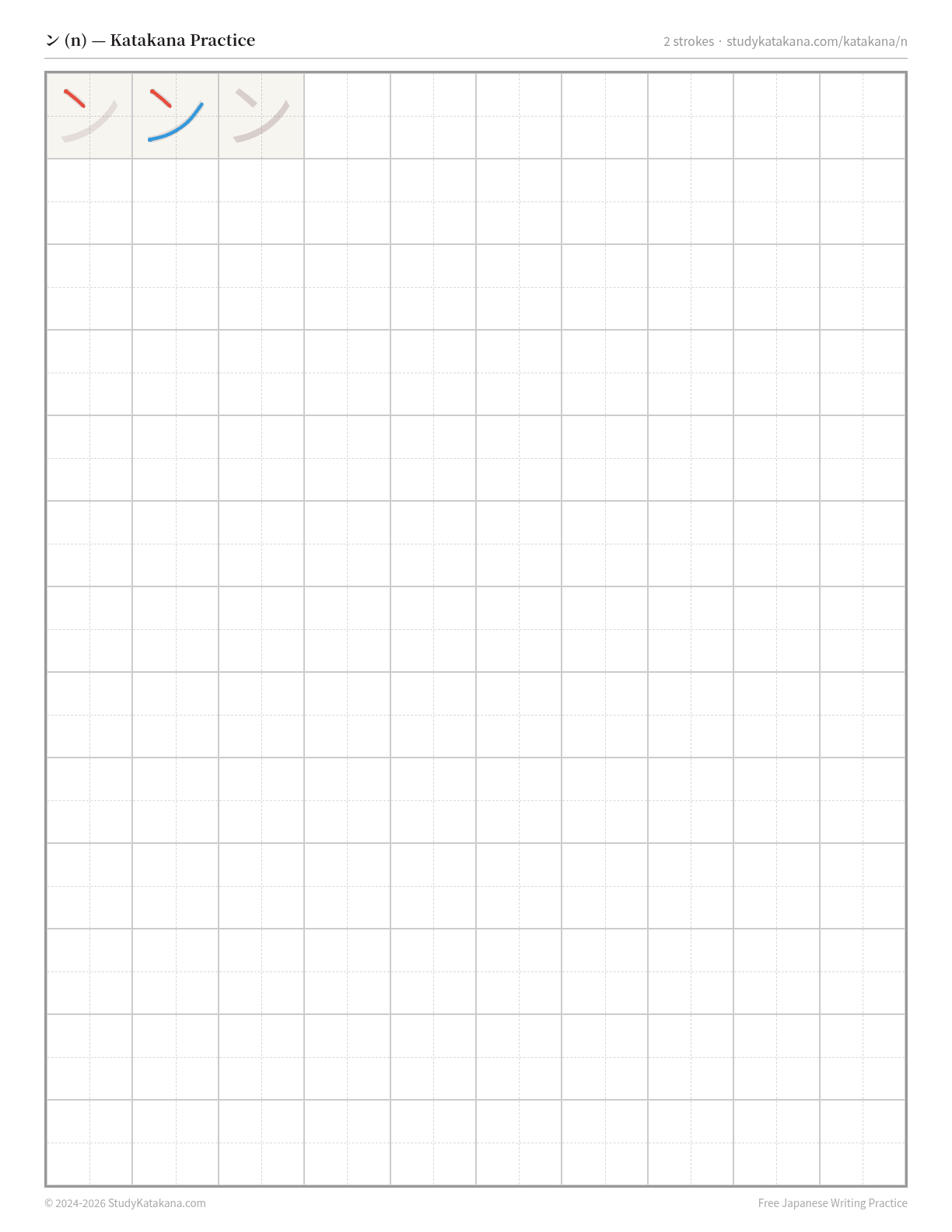
Print this worksheet to practice writing ン by hand — the top row shows the stroke order to trace, then fill the blank squares.
Lock it into memory
Reading is only half of it. Write the katakana you’ve learned from memory in the trainer — the ones you struggle with come back sooner, until they stick.