nyu / にゅ
The middle NY combined kana — に plus a small ゅ becomes 'nyu', a single syllable. Anchors a huge family of '〜入' (entering) compounds — school, hospital, etc.
Pronunciation
The compound character にゅ represents the syllable 'nyu', formed by combining に (ni) with a small ゅ. It is pronounced as a single syllable 'nyu'.
にゅ is に (ni) plus a small ゅ (yu). Together they make a single syllable /nyu/ — similar to the British English pronunciation of "new" or the start of "nuance". It anchors a huge family of compounds built around 入 (the kanji for "enter"): 入学 (nyuugaku, "entering school"), 入院 (nyuuin, "hospital admission"), 入門 (nyuumon, "introduction / primer"), 入社 (nyuusha, "joining a company"), 入場 (nyuujou, "entry / admission"), 入浴 (nyuuyoku, "taking a bath"). It also appears in 牛乳 (gyuunyuu, "milk") and 豆乳 (tounyuu, "soy milk").
How to write にゅ
Trace にゅ on the canvas at the top of the page. Animated arrows show each stroke's direction; trace along them and the stroke fills in. Each numbered step below explains what that stroke does.
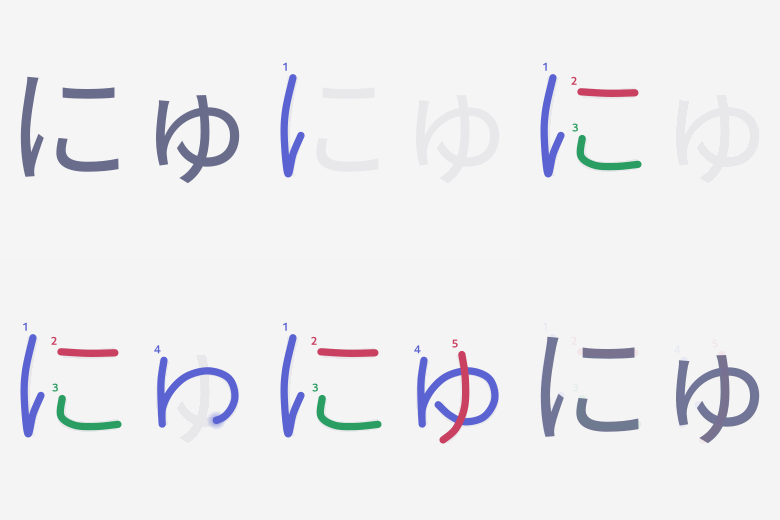
Write に exactly: three strokes.
Write a small ゅ next to に. Stroke 4 is the small looping body (a tiny tear-drop); stroke 5 is the horizontal anchor crossing through it. Keep ゅ at roughly half the height of に.
Origin
にゅ is the written combination of に (from 仁, ni) and a small ゆ (from 由, yu). The palatalized /nyu/ sound is uncommon in native Japanese vocabulary but extremely common in Sino-Japanese compounds — especially anything involving 入 "enter" or 乳 "milk".
Common words starting with にゅ
Printable practice sheet
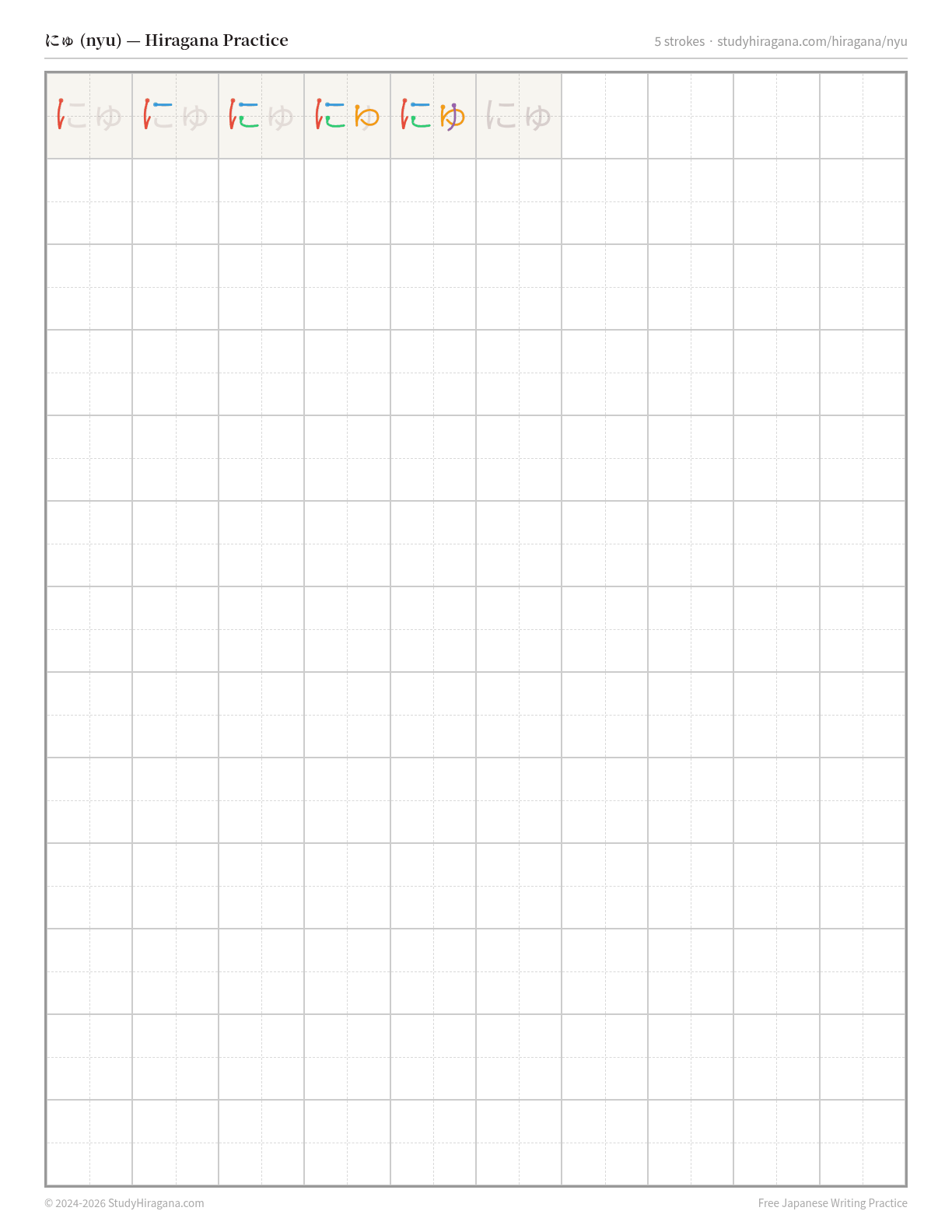
Print this worksheet to practice writing にゅ by hand — the top row shows the stroke order to trace, then fill the blank squares.
Lock it into memory
Reading is only half of it. Write the hiragana you’ve learned from memory in the trainer — the ones you struggle with come back sooner, until they stick.