no / の
The last of the N row — a single flowing stroke 'no' that is the most-used particle in Japanese.
Pronunciation
The character の represents the syllable 'no', a soft 'n' followed by 'o'. Part of the な-row. The particle の (the possessive 'of') is one of the most common words in Japanese — you'll see it constantly.
の closes the N row and is one of the most-used hiragana you'll ever write. As a particle, の links two nouns to express possession or attribution — 私の本 ("my book"), 日本の食べ物 ("Japanese food"). It also appears in 飲む (to drink), 残す (to leave behind), and dozens of compound nouns. One single curling stroke; almost a circle.
How to write の
Trace の on the canvas at the top of the page. Animated arrows show each stroke's direction; trace along them and the stroke fills in. Each numbered step below explains what that stroke does.

A single flowing stroke shaped like a counter-clockwise spiral. Start at the upper right, sweep down and to the left, curl around the lower middle, then loop back up and around to the right with a small flick at the upper center. The character should look like a number 9 written in reverse — one smooth motion, no lifts.
Origin
Hiragana の evolved from the cursive form of the kanji 乃 (no) — meaning "of" or "and so." The kanji's two flowing strokes compressed into the single spiraling line we write today, preserving only the essential counter-clockwise sweep that gives の its distinctive shape.
Common words starting with の
Printable practice sheet
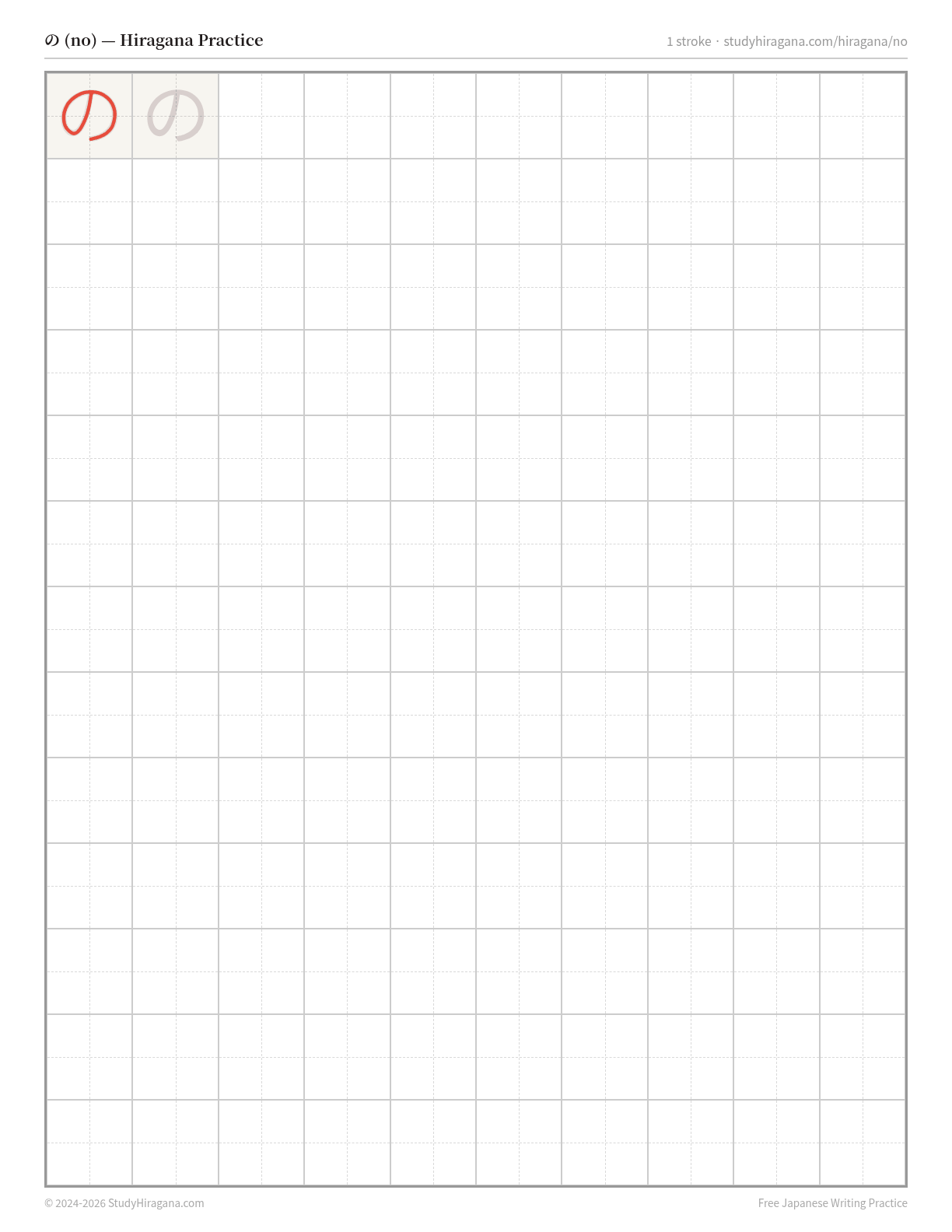
Print this worksheet to practice writing の by hand — the top row shows the stroke order to trace, then fill the blank squares.
Lock it into memory
Reading is only half of it. Write the hiragana you’ve learned from memory in the trainer — the ones you struggle with come back sooner, until they stick.