kya / きゃ
The first KY combined kana — き plus a small ゃ becomes 'kya', a single syllable. Anchors guests, customers, and baseball.
Pronunciation
The compound character きゃ represents the syllable 'kya', formed by combining き (ki) with a small ゃ (ya). The combination changes the vowel of き from 'i' to a 'ya' sound, producing the single syllable 'kya' — not 'ki-ya'. This pattern (consonant+i + small ya/yu/yo) is called yōon and creates many essential Japanese sounds.
きゃ is き (ki) plus a small ゃ (ya). The two characters together produce a single syllable — /kya/, not /ki-ya/. The small ゃ is unmistakably smaller than full-size ya; it tucks into the lower-right area of き. きゃ anchors 客 (kyaku, "guest / customer"), 客間 (kyakuma, "guest room"), 脚 (kyaku, "leg" in compounds), 野球 (yakyuu, "baseball" — uses きゅう), and 逆 (gyaku, "opposite" — dakuten variant ぎゃ). Pronunciation: don't insert a vowel between consonant and y — slide directly from /k/ into /ya/.
How to write きゃ
Trace きゃ on the canvas at the top of the page. Animated arrows show each stroke's direction; trace along them and the stroke fills in. Each numbered step below explains what that stroke does.
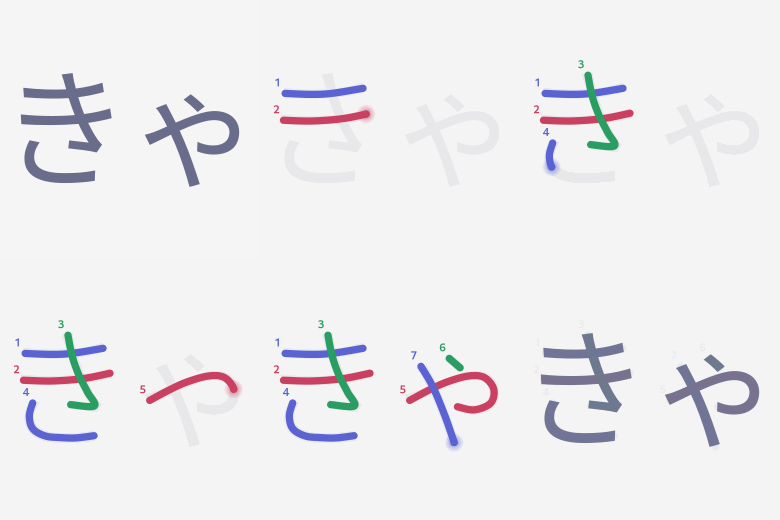
Write き exactly: stroke 1 a short horizontal at the top; stroke 2 a longer horizontal below it; stroke 3 a curving vertical that drops down through both horizontals; stroke 4 a small detached hook at the lower left.
Write a small ゃ next to き, tucked into the lower right. Stroke 5 is a short slanted dash; stroke 6 is the looping body (smaller version of や's main stroke); stroke 7 is the tiny upper-right accent. Keep ゃ at roughly half the height of き — the size difference is what marks it as a combiner.
Origin
きゃ isn't a single historical kana — it's a written combination of き (from 幾, ki) and a small や (from 也, ya). The yōon system was codified in the Meiji period (late 19th century), when the small-ya/yu/yo convention was standardized to spell the palatalized syllables that had existed in Japanese speech for centuries but lacked a consistent writing form.
Common words starting with きゃ
Printable practice sheet
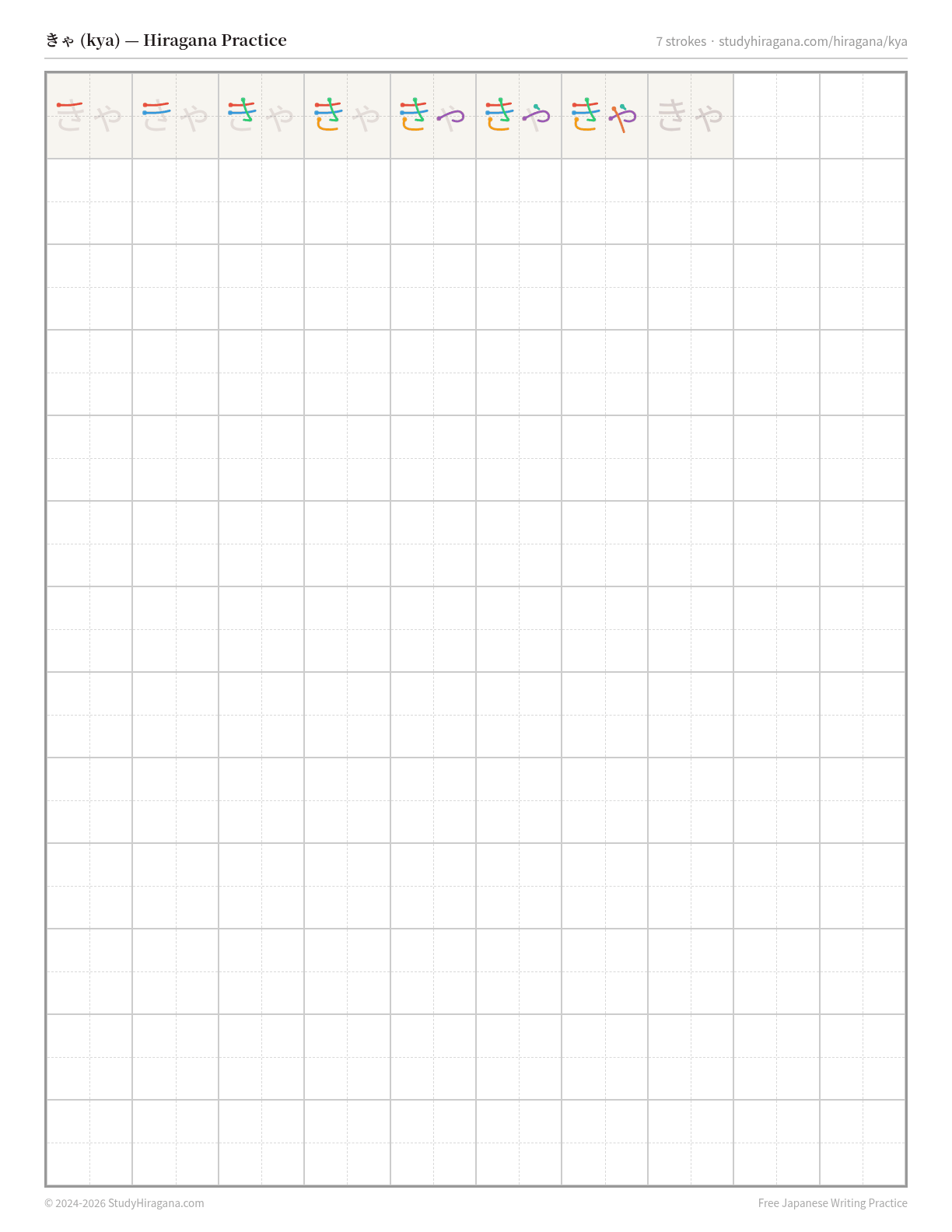
Print this worksheet to practice writing きゃ by hand — the top row shows the stroke order to trace, then fill the blank squares.
Lock it into memory
Reading is only half of it. Write the hiragana you’ve learned from memory in the trainer — the ones you struggle with come back sooner, until they stick.