ja / じゃ
The first J combined kana — じ plus a small ゃ becomes 'ja'. The casual copula 'isn't' (じゃない) and the conversation-closer 'well then' (じゃあ).
Pronunciation
The compound character じゃ represents the syllable 'ja', formed by combining じ (ji) with a small ゃ. The dakuten on じ voices the consonant from 'sh' to 'j'. It is pronounced as a single syllable 'ja' (like the 'ja' in 'jacket').
じゃ is じ (ji) plus a small ゃ (ya). Together they make a single syllable /ja/ — sounding exactly like English "ja" in jar. It's one of the most-used kana sequences in spoken Japanese, anchoring the casual copula: じゃない ("isn't / aren't", contracted from ではない), じゃ (the casual copula contraction of では), じゃあ ("well then / see you / so" — used to open and close conversations, and as a soft transition word). It also anchors 邪魔 (jama, "a bother / hindrance") and 蛇 (hebi, "snake" — but じゃ in compound forms like 蛇口 jaguchi, "faucet").
How to write じゃ
Trace じゃ on the canvas at the top of the page. Animated arrows show each stroke's direction; trace along them and the stroke fills in. Each numbered step below explains what that stroke does.
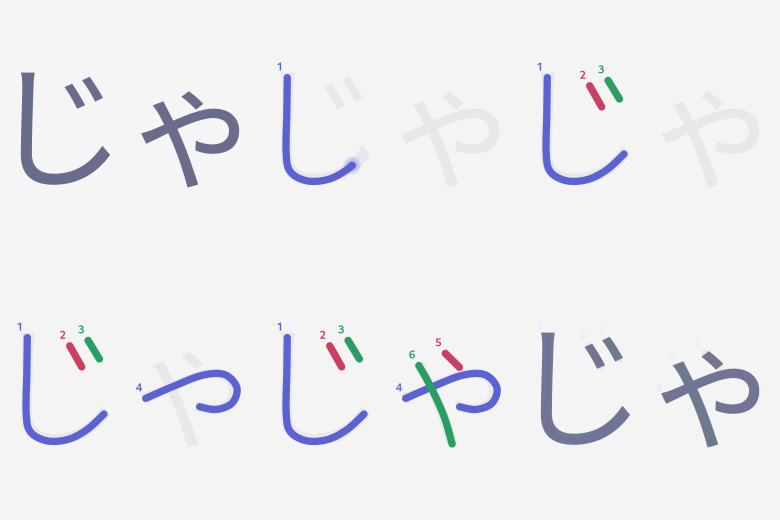
Write じ exactly: three strokes for し plus the dakuten ゛ — three strokes (one for し, two for the ticks).
Write a small ゃ next to じ, tucked into the lower right. Stroke 4 is a short slanted dash; stroke 5 is the looping body; stroke 6 is the tiny upper-right accent. Keep ゃ at roughly half the height of じ.
Origin
じゃ is the written combination of じ (し + dakuten ゛, from 之 shi) and a small や (from 也, ya). The /ja/ sound is everywhere in spoken Japanese — most often as the contracted casual copula じゃ (from では), one of the most-used grammatical morphemes in the entire language.
Common words starting with じゃ
Printable practice sheet
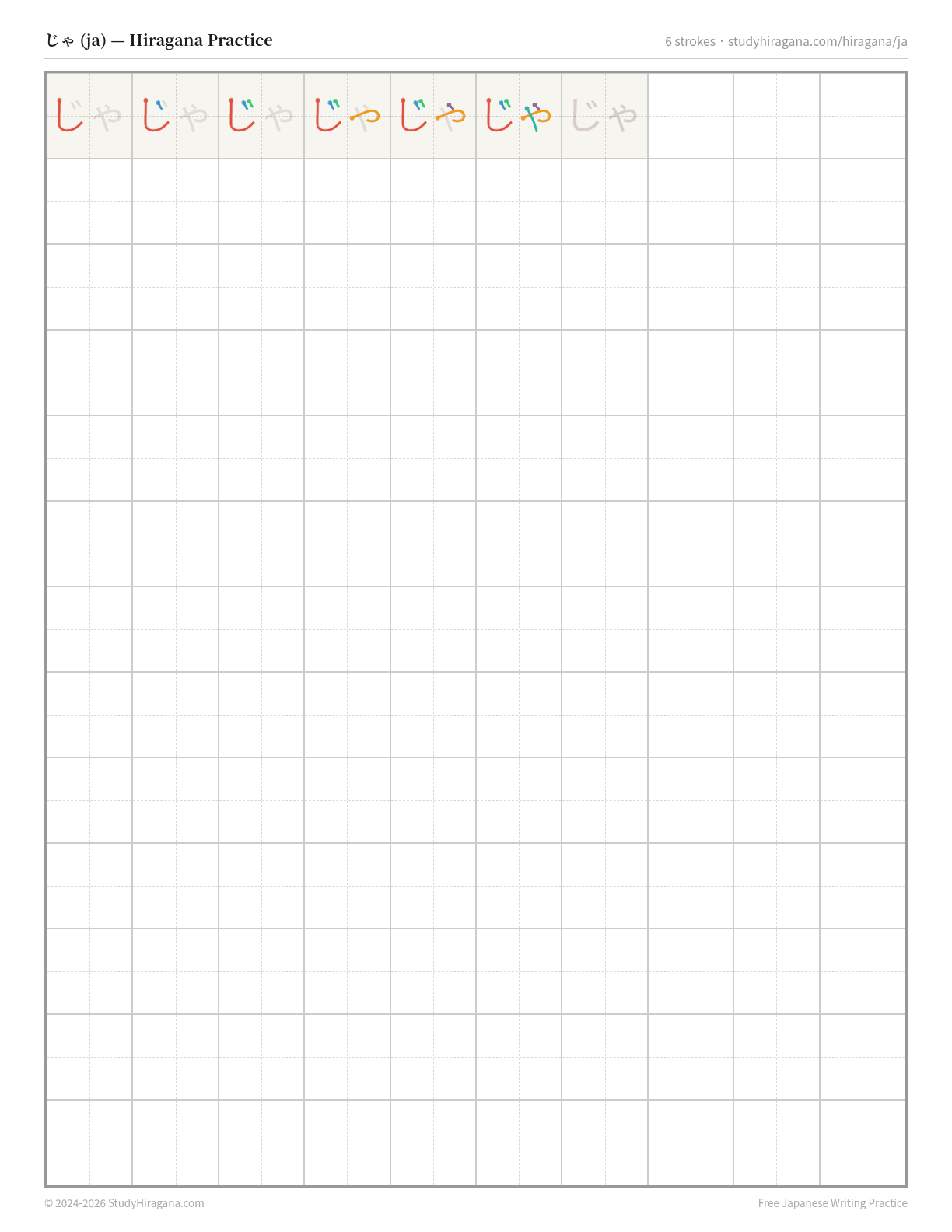
Print this worksheet to practice writing じゃ by hand — the top row shows the stroke order to trace, then fill the blank squares.
Lock it into memory
Reading is only half of it. Write the hiragana you’ve learned from memory in the trainer — the ones you struggle with come back sooner, until they stick.