di / ぢ
The second of the D row — ち with two tiny ticks (゛) becomes 'ji' (sounds identical to じ). Rare in modern Japanese — appears mainly in specific compounds like 鼻血 (nosebleed).
Pronunciation
The character ぢ represents the syllable pronounced 'ji' in modern Japanese (identical to じ). It is ち with the dakuten. Historically the syllable was distinct, but in modern usage じ is the default for 'ji'; ぢ appears mainly in compound words where ち becomes voiced (e.g., はなぢ — nosebleed).
ぢ is ち (chi) plus the dakuten ゛. Despite its T-row origin and the romaji di, it's pronounced identically to じ — both sound like English jee. Historically Japanese had two distinct sounds, but they merged centuries ago. In modern writing, ぢ appears only in specific compound words where the second element originally started with ち, especially 鼻血 (hanaji, "nosebleed") and a few names. For nearly every other ji, write じ. The romaji di is a transliteration convention used to distinguish ぢ from じ on the page — it does NOT reflect a different sound.
How to write ぢ
Trace ぢ on the canvas at the top of the page. Animated arrows show each stroke's direction; trace along them and the stroke fills in. Each numbered step below explains what that stroke does.
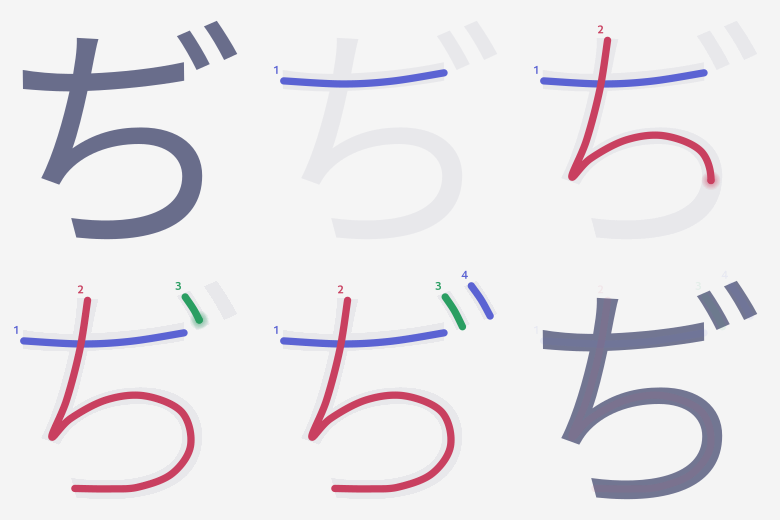
Write ち exactly: stroke 1 a short slanted horizontal near the top; stroke 2 a long flowing curving stroke that begins at the top right, crosses stroke 1, sweeps down through the middle, loops around at the bottom in a closed lower-right curl, and exits with a small flick.
Add the dakuten (゛): two small tick marks at the upper right. Strokes 3 and 4 are the two ticks.
Origin
Hiragana ぢ shares its base shape with ち, which evolved from the kanji 知 (chi, "to know"). Old Japanese distinguished /di/ from /ji/, but the sounds merged by the early modern period; ぢ survives in writing for historical compounds, but in speech it's identical to じ.
Common words starting with ぢ
Printable practice sheet
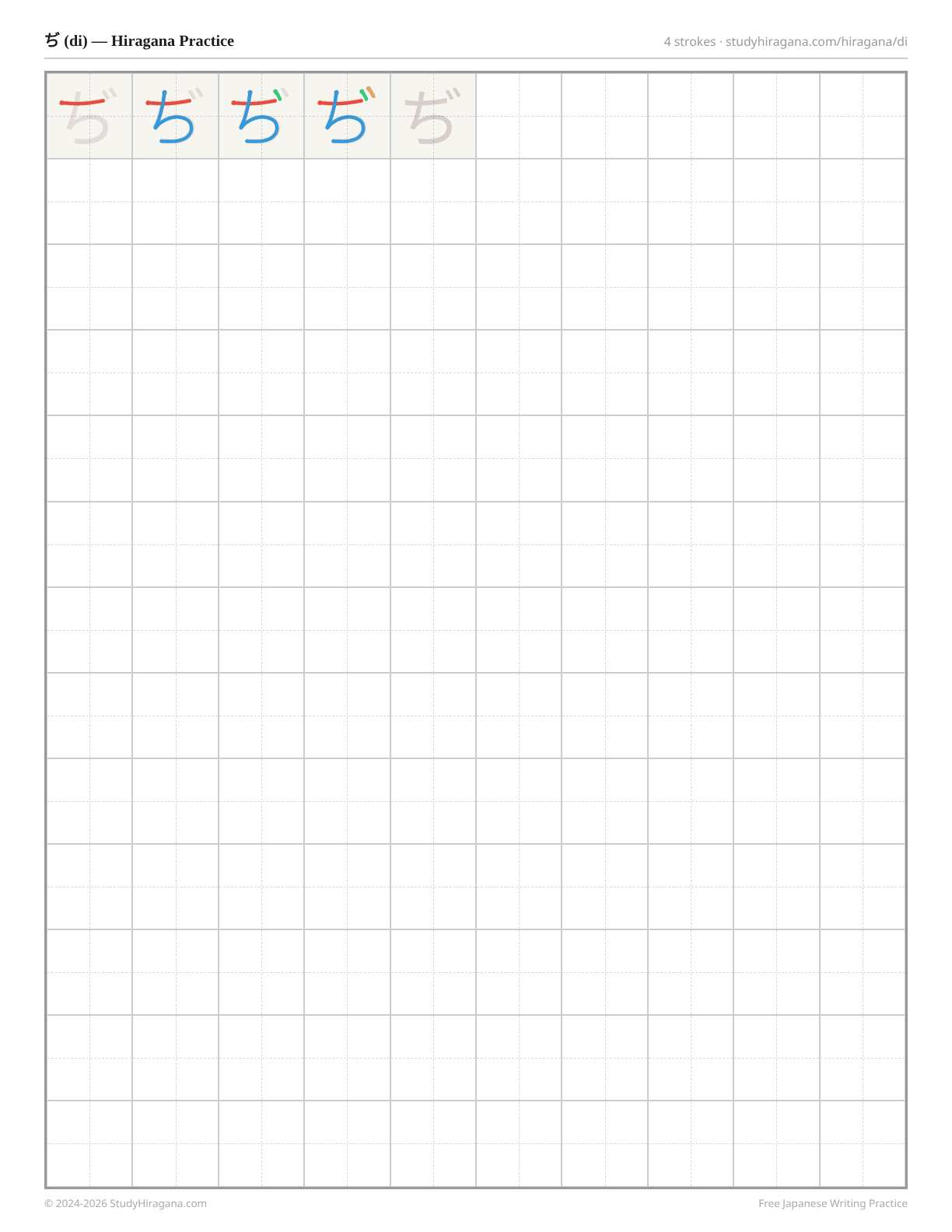
Print this worksheet to practice writing ぢ by hand — the top row shows the stroke order to trace, then fill the blank squares.
Lock it into memory
Reading is only half of it. Write the hiragana you’ve learned from memory in the trainer — the ones you struggle with come back sooner, until they stick.