be / べ
The fourth of the B row — へ with two tiny ticks (゛) becomes 'be'. Anchors the words for study (勉強) and boxed lunch (弁当).
Pronunciation
The character べ represents the syllable 'be', a soft 'b' followed by 'e' as in 'pet'. It is へ with the dakuten that voices 'h' to 'b'.
べ is へ (he) plus the dakuten ゛. It's three strokes total — the simplest B-row character to write. べ anchors 勉強 (benkyou, "study / practice"), 弁当 (bentou, "boxed lunch"), 別 (betsu, "different / separate"), 部屋 (heya, "room" — uses へ, but 部 alone reads as be in some compounds). Word-initial べ is /be/. Note: when the H-row base へ is used as a direction particle, it's pronounced e, but with dakuten it always becomes /be/.
How to write べ
Trace べ on the canvas at the top of the page. Animated arrows show each stroke's direction; trace along them and the stroke fills in. Each numbered step below explains what that stroke does.

Write へ exactly: a single angular stroke shaped like a low chevron or shallow caret. Start at the lower left, sweep up to a peak in the upper middle, then sweep back down to the lower right. The angle is wide and flat, almost a straight line with a single rise in the middle.
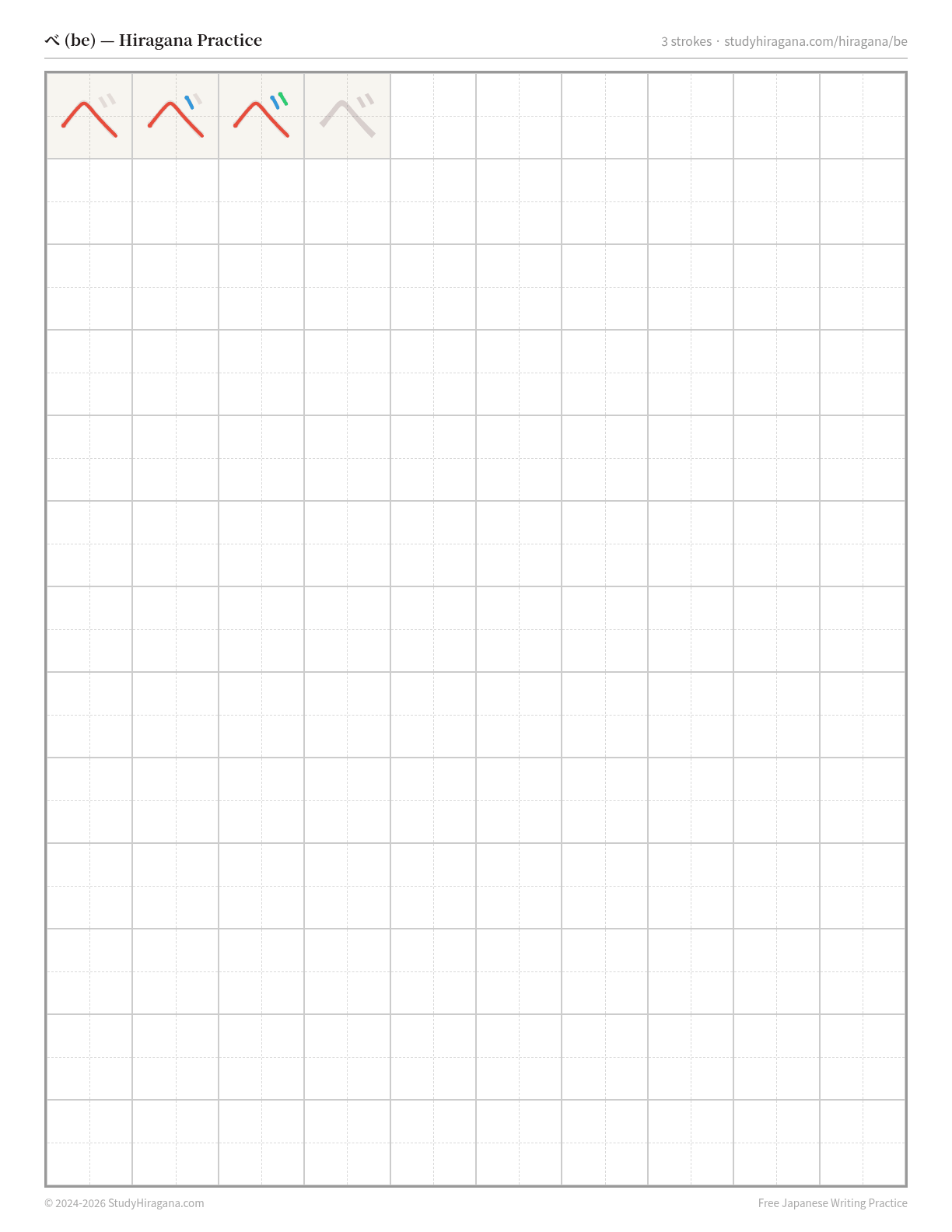
Add the dakuten (゛): two small tick marks at the upper right. Strokes 2 and 3 are the two ticks.
Origin
Hiragana べ shares its base shape with へ, which evolved from the kanji 部 (he, "section / department" — read also as be in compounds). The kanji's right radical compressed into the single angular stroke of へ; the dakuten ゛ voiced /he/ into /be/. The same shape with handakuten ゜ becomes ぺ (pe).
Common words starting with べ
Printable practice sheet
Print this worksheet to practice writing べ by hand — the top row shows the stroke order to trace, then fill the blank squares.
Lock it into memory
Reading is only half of it. Write the hiragana you’ve learned from memory in the trainer — the ones you struggle with come back sooner, until they stick.