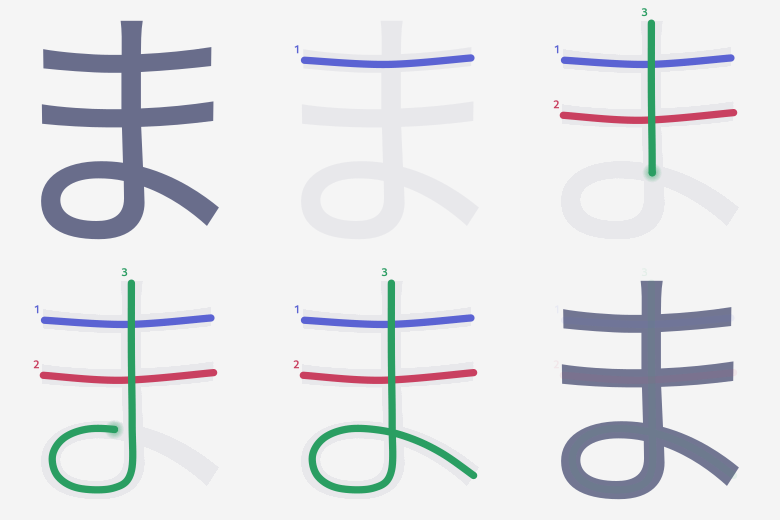
ま (ma)
Pronunciation
The character ま represents the syllable 'ma', a soft 'm' followed by 'a' as in 'father'. It is the first character of the ま-row.
Stroke-by-Stroke Guide
ま is written in three strokes. Stroke 1: a horizontal line near the top, written from left to right. Stroke 2: a second longer horizontal line below stroke 1, parallel to it. Stroke 3: a long vertical line that crosses through both horizontals, then curves at the bottom into a small loop on the lower left, ending with a small inward hook. The bottom curl is the defining feature of ま.
Common Words with ま
- たまご (tamago) — eggs / egg / spawn
- とまる (tomaru) — to stop / to come to a stop
- まわる (mawaru) — to turn / to rotate / to revolve
- かたまり (katamari) — lump / mass / bundle
- いま (ima) — now / the present time / just now
- うま (uma) — horse
- くま (kuma) — bear
- しま (shima) — island
- たま (tama) — ball / sphere / globe
- たましい (tamashii) — soul / spirit / mind
- つま (tsuma) — wife
- ぬま (numa) — marsh / swamp / wetland
- はま (hama) — beach / seashore
- ひま (hima) — spare time / free time / leisure
- まご (mago) — grandchild
- また (mata) — again / once more / once again
- まち (machi) — town / block / neighbourhood
- まつ (matsu) — pine tree
- まど (mado) — window
- まゆ (mayu) — eyebrow / eyebrows
How to Write ま (ma) in Hiragana
The hiragana character ま is romanized as "ma" and is written with 3 strokes. Like "ma" in "mama". Example word: まど (mado) — window.
Stroke Order for ま
When writing ま, follow the numbered stroke order shown in the reference character above. Japanese characters are generally written from left to right and top to bottom. Correct stroke order improves readability and writing speed.
Practice Tips
- Print this sheet on standard 8.5" × 11" letter paper
- Start by tracing the light grey guide characters in the first column
- Then practice writing ま freehand in the empty squares
- Pay attention to stroke direction and order — follow the numbered guide
- For interactive practice with animations, visit the main study page
About Hiragana
Hiragana is one of the three Japanese writing systems. It consists of 46 basic characters, each representing a syllable. Hiragana is used for native Japanese words, grammar particles, and verb endings. Learning correct stroke order is essential for proper Japanese handwriting.