su / ス
The middle of the S row — a brisk “su” in two strokes. Same sound as hiragana す, fronting supermarket, sports, and spoon.
Pronunciation
The character ス represents the syllable 'su', identical in pronunciation to hiragana す. Extremely common in loanwords — appears in countless everyday words (supermarket, sports, smartphone, spoon, steak).
ス shares hiragana す's sound — a light “su” with relaxed lips. It begins a long list of loanwords: スーパー (supermarket), スポーツ (sports), スプーン (spoon), スキー (ski). In casual speech ス also clips long words, as in スマホ (smartphone).
How to write ス
Trace ス on the canvas at the top of the page. Animated arrows show each stroke's direction; trace along them and the stroke fills in. Each numbered step below explains what that stroke does.
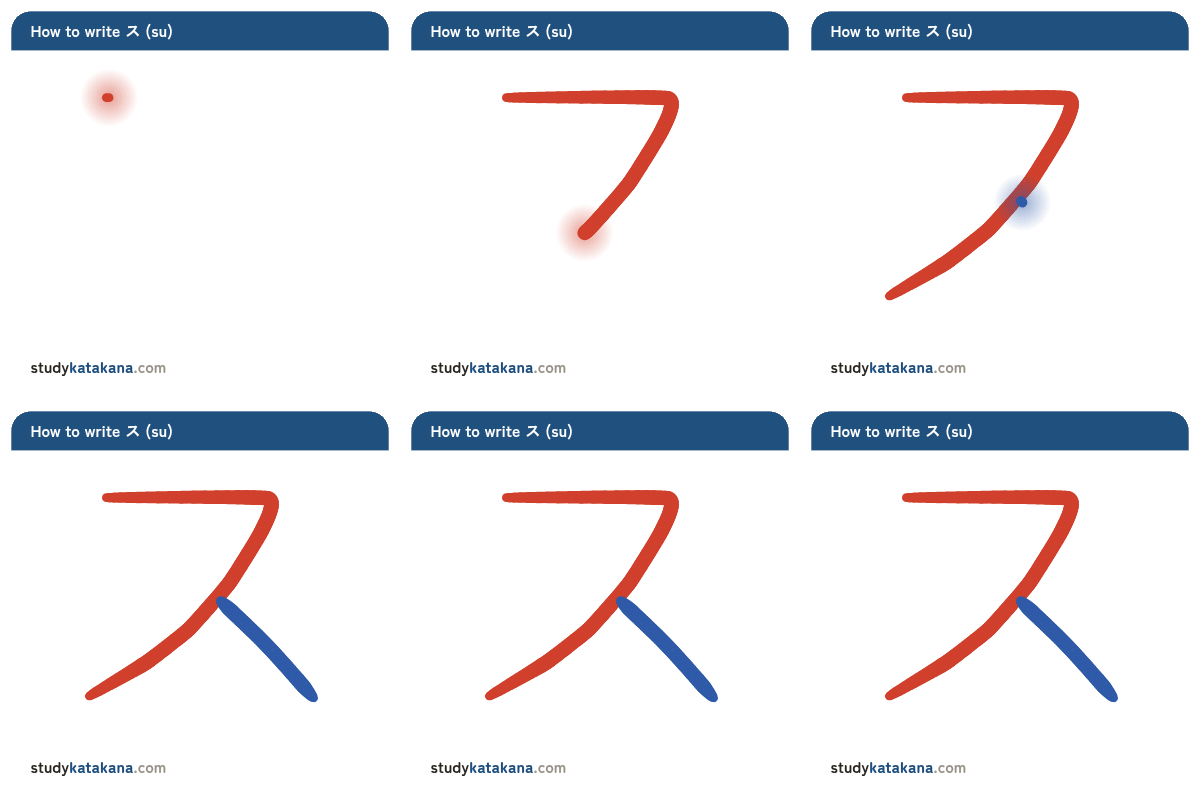
Start at the upper left, draw across to the right, then sweep down and back to the lower left in one motion — the top and the long diagonal.
A short diagonal branching from the middle, kicking out to the lower right — the supporting leg.
Origin
Katakana ス is a fragment of the kanji 須 (su, “must” or “necessary”). A pair of its strokes survived the monks' shorthand; the busy remainder of 須 was set aside.
Common words starting with ス
Printable practice sheet
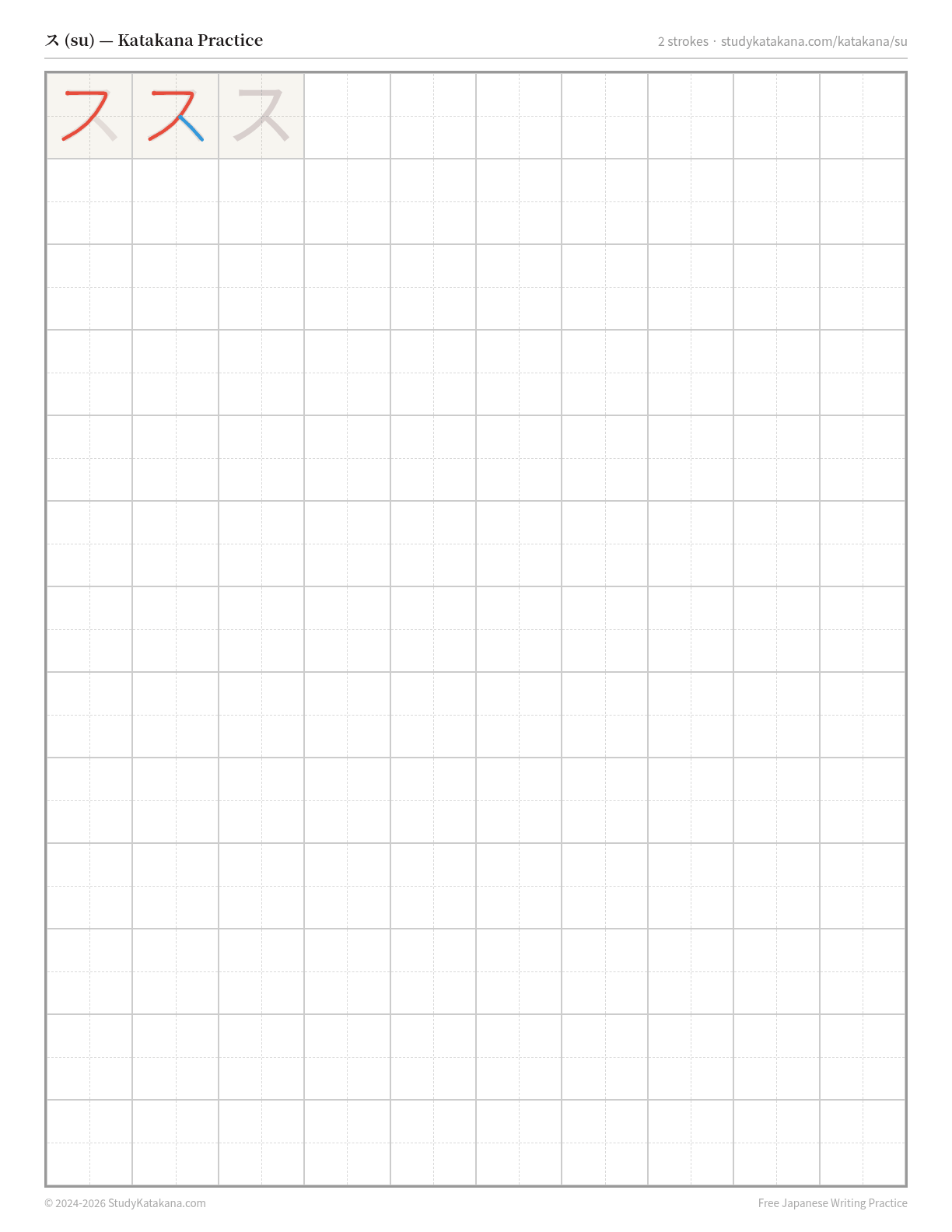
Print this worksheet to practice writing ス by hand — the top row shows the stroke order to trace, then fill the blank squares.
Lock it into memory
Reading is only half of it. Write the katakana you’ve learned from memory in the trainer — the ones you struggle with come back sooner, until they stick.