水 / water
One of the first kanji every learner meets — the character for water, and the root of an entire family of liquid-related kanji.
Cara baca
| Jenis | Cara baca | Catatan |
|---|---|---|
| On (音) | スイ | Cara baca Sino-Jepang — umum dalam kata majemuk. |
| Kun (訓) | みず | Cara baca asli Jepang — umum berdiri sendiri atau dengan okurigana. |
水 carries two everyday readings. On its own as a noun, it's みず (mizu) — the kun reading you'll use to ask for water at a restaurant, point to a glass, or label a tap. In compounds it usually shifts to its on reading, スイ (sui), inherited from Middle Chinese — that's what you hear in 水曜日 (suiyōbi, Wednesday) and 水分 (suibun, moisture).
Arti
Beyond literal water, 水 anchors a wide family of kanji and words that touch anything liquid, fluid, or watery. As a radical it's written 氵 (the "three drops") and shows up in 海 (sea), 池 (pond), 河 (river), 油 (oil), and dozens more. Recognising 氵 in the wild is one of the fastest ways to start guessing the rough meaning of unfamiliar kanji.
Cara menulis 水
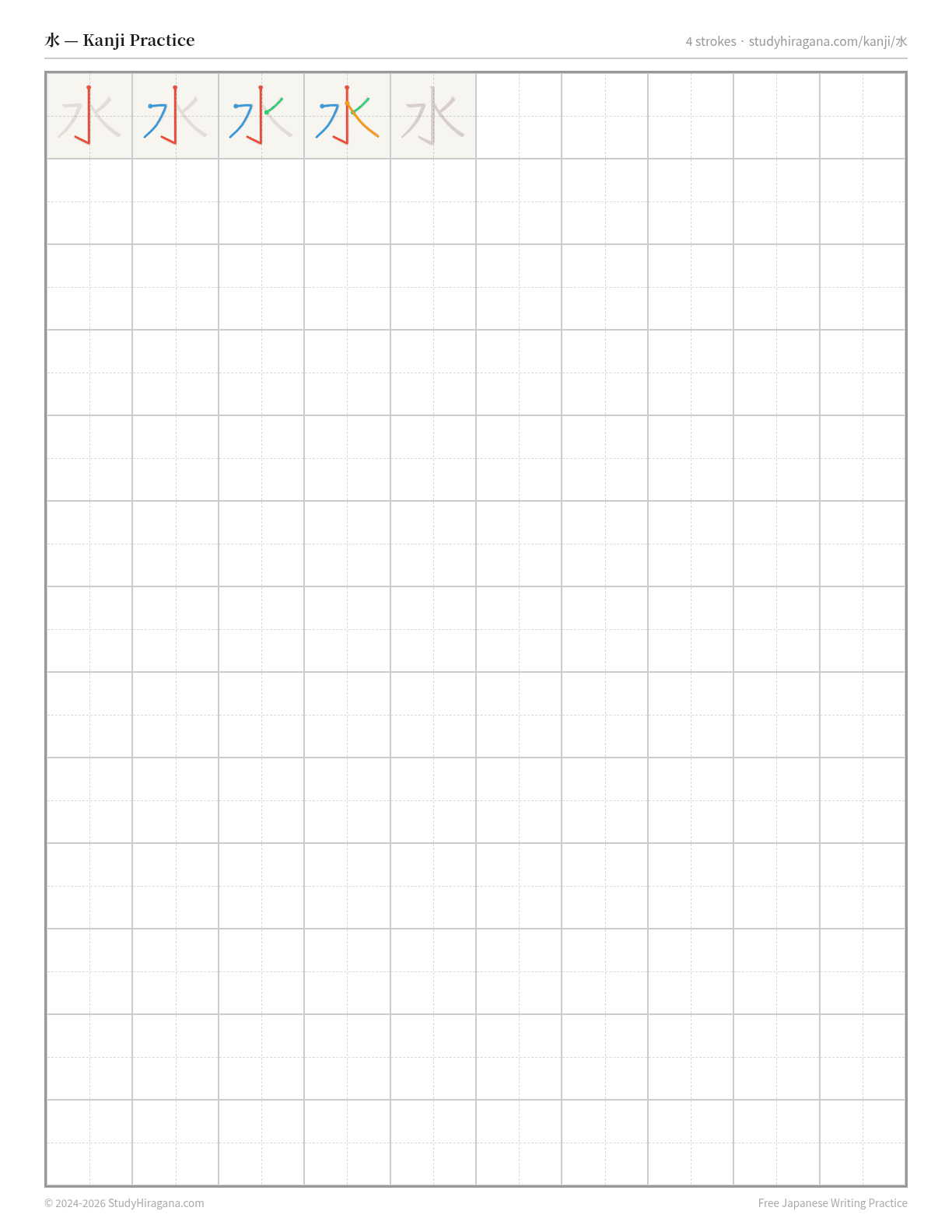
Telusuri 水 pada kanvas di bagian atas halaman. Panah animasi menunjukkan arah setiap goresan; langkah-langkah di bawah menjelaskan apa yang dilakukan masing-masing.
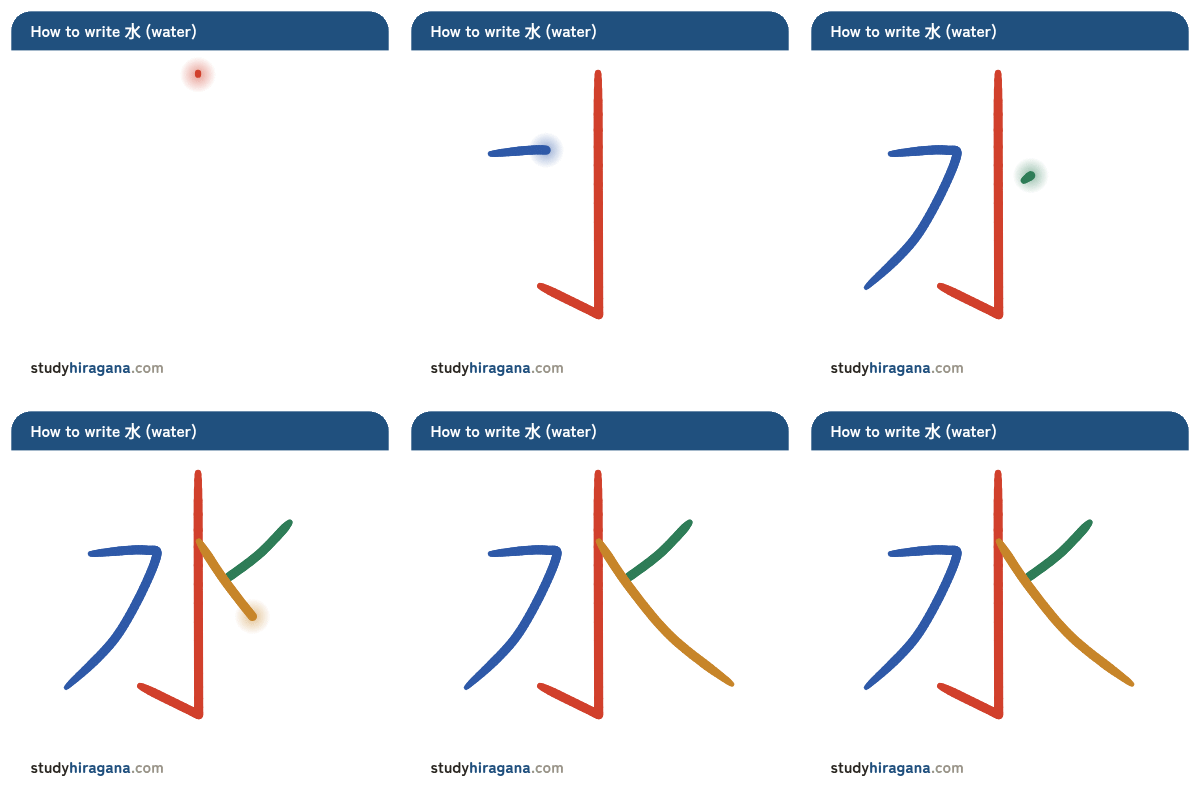
A short downward stroke through the centre — the central spine the rest of the character hangs from. Start above the midpoint and pull straight down, lifting cleanly at the bottom.
A small leftward sweep from the centre. Start halfway down the central stroke and curve outward to the lower left, like a single drop running off.
A diagonal that mirrors the second stroke on the right side. Begin at the upper area, curve down and slightly outward to the lower right.
The final outward flick on the far right. A short diagonal that completes the symmetrical "splash" shape and gives 水 its sense of motion.
Asal usul
水 is a pictograph — one of the oldest characters in the Chinese writing system. The earliest oracle-bone forms (c. 1200 BCE) literally drew flowing water: a vertical central current with droplets or eddies spilling off either side. Over millennia those droplets stylised into the four strokes we write today, but the symmetry around a central axis still reads as a stream in motion.
When 水 appears on the left of a compound kanji it gets squeezed into the 氵 form (three short strokes, called sanzui, "three-drops water"). When it sits below or as a base it stays close to its full form. Either way, 氵/水 is one of the most productive radicals in Japanese — a strong signal that the kanji has something to do with liquid, weather, or flow.
Kata majemuk umum dengan 水
水 dalam konteks
9月7日は水曜日です。
くがつなのかはすいようびです
September 7th is Wednesday.
水を飲みます。
みずをのみます
I drink water.
水泳を習います。
すいえいをならいます
I learn swimming.
Lembar latihan yang dapat dicetak
Cetak lembar ini untuk berlatih menulis 水 dengan tangan — baris atas menunjukkan urutan goresan untuk ditiru, lalu isi kotak-kotak kosongnya.